
Articles Tagged with: Journey Across the Strait III
medinv-journal_calabria-19.jpg

CALABRIA IS IN CONSTANT MOTION, BUT SOMETIMES ITS COURSE IS THE WRONG ONE. LET US ABANDON OLD PROCESS MODELS AND FACE OUR “ARCHAIC FUTURE” with Salvatore Greco

Salvatore Greco, architect and council member of the Order of the Architects of Reggio Calabria, overturns the preconceived narrative of a poor Calabria. Its supposed poverty exists only in the eyes of the those who are unable to see.

Calabria is wealth”
Salvatore Greco opens with this stement, immediately and decisivly removing one of the many stereotypes surrounding Calabria as a “poor region”. It is a beautiful narrative by Greco one that does not indulge in sentimentality but instead develops a rigorous analysis grounded in observation and the memory of places. An alternating vision – close-up and from a distance – that returns the most honest and passionate portrait of the South.

Calabria is rich in perceptions. Its highly distinctive morphology is itself a form of wealth.
It is a mountainous region, made of mountains that face each other across the seas (the Ionian and the Tyrrhenian), and the physical space between the coasts and the Aspromonte is filled with countless stories.
Eight hundred kilometers of coastline, pastoral culture and cuisine…other narratives and forms of wealth.
Another form of wealth is the Calabrian “unfinished”: the rebar of pillars emerging from slabs, awkward volumes rising up, unfulfilled promises of houses – behind every house there is a social story, and this is wealth. Further wealth is the suspended sense of time, as if it stops and then resumes.
A sad form of wealth, but still wealth, is that of lands abandoned due to economic necessity, hydrogeological instability, earthquakes, and floods.
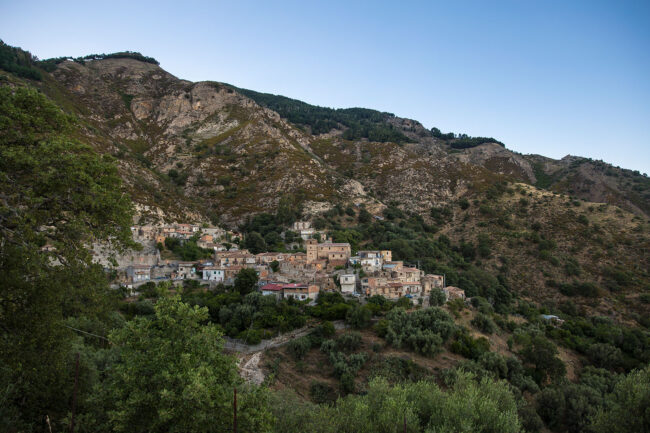
There is also the wealth of ghost towns, where only the past exists, while present and future are merely illusory intentions: the village of Amendolea and its river, the Cretto di Burri in Gibellina, which tells not what once existed, but its disappearance, the aftermath of the earthquake. The linguistic richness of the Grecanic area (certainly not a “minority” – a word that feels wrong and contradicts its enchantment and fascination).

Again, suspended time. All of this is wealth.

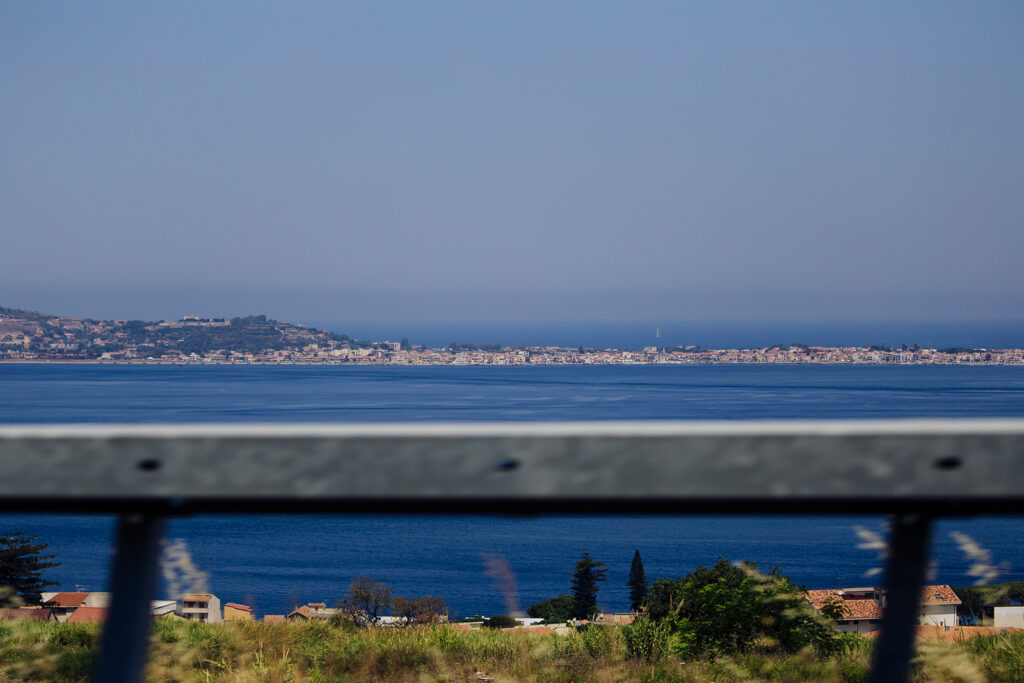
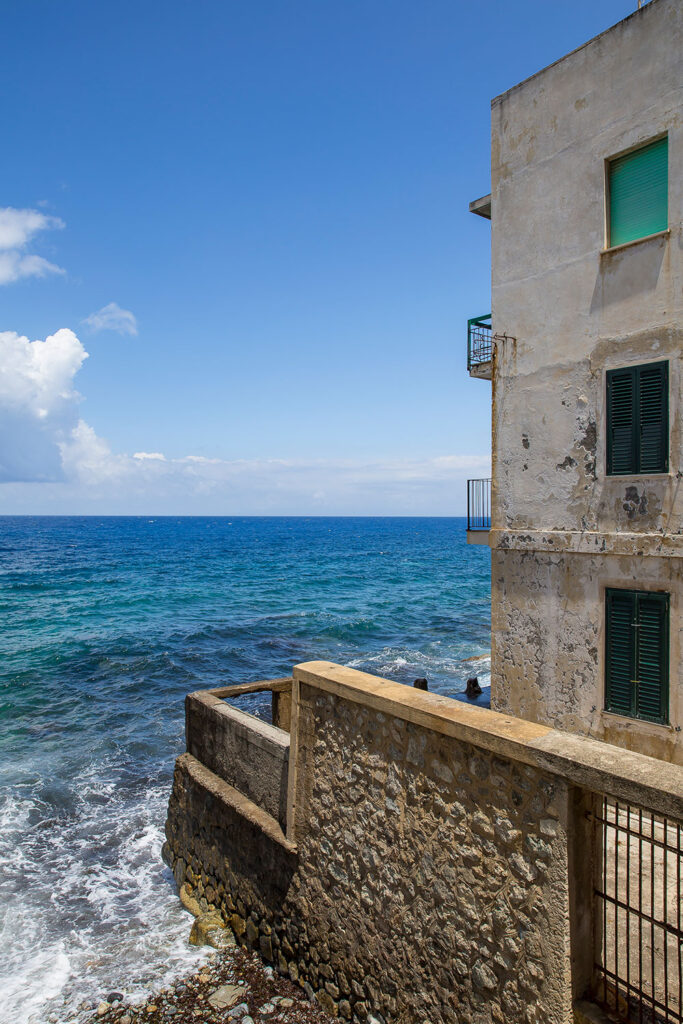
Photo by Stefano Anzini.
Then we move into the question of how to use and invest this extraordinary value.
A first reflection is that some of these situations have been preserved precisely because they have remained inaccessible.
And while invisibility and inaccessibility can certainly have negative connotations, I believe it is preferable to maintain an extreme form of protection rather than resorting to misguided interventions or restoration approaches that turn villages into something resembling and “Indian reservation”.
That would mean losing wealth rather than gaining it – making room for a form of consumption that empties places out, a throwaway use of territories.
Change, “progress”, even in its most aggressive forms, has reached Calabria filtered through its environmental character and geography – sometimes hostile – and this has caused less damage than in other regions.
We must encourage a delicate form of tourism, one that is not offensive or arrogant.
Landscapes transformed into postcard panoramas end up aligning with an undifferentiated mass of postcard-like landscapes.
The danger is that the richness of values is reduced to a merely transitory purchasing power – and the lost forever.

Can the authenticity of the Calabrian territory be reconciled within a European framework? The provocation we are putting forward with Invisible Mediterranean(s) is that of restarting the country (and Europe as well) from the southern Mediterranean.
These are not separate positions, but shared objectives grounded in respect for identity.
In Calabria there is no strong opposition between countryside and city; our wealth comes from the rural world and can be interpreted and strengthened within a European perspective. We are cities, villages, and communities: we must relaunch the vision of the world within and through communities.
For this reason, I believe a surgical level of attention is needed in how tourism is directed. And we must do this ourselves, as Calabrians.
Many things have been “dropped from above” onto us – for example investments in the steel industry, despite its crisis (with Taranto already struggling as a competitor). The Port of Gioia Tauro later managed to transform itself into a transshipment hub, but generating little local spin-off. The port is in fact a ZES–Special Economic Zone–which means that production and processing take place and exchange happens within the port itself. However, the lack of adequate rail infrastructure and railway terminals hinders the development of a potential local economic ecosystem.

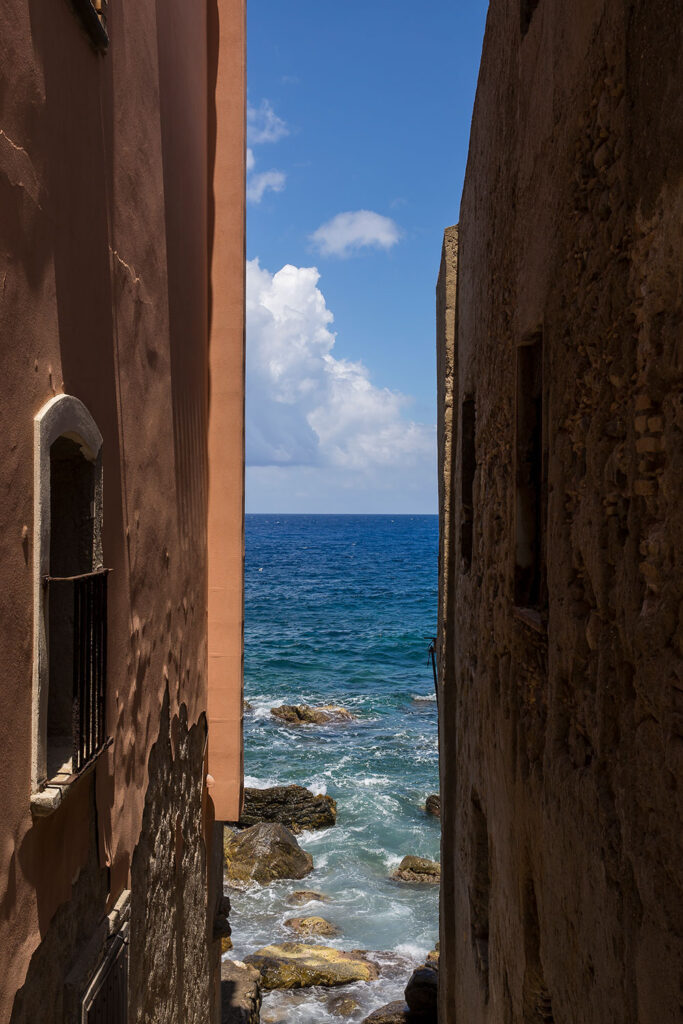
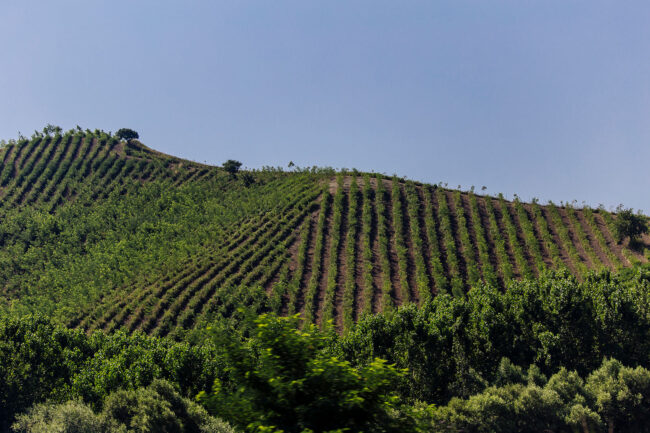
Photo by Stefano Anzini.
We simply need to return to being what we once where, without anachronistic positions, within a framework of real change.
Calabria is in constant motion, but too often the course it takes is the wrong one.
We can speak a great deal about conservation– about architecture, landscape, and places. But places and landscapes exist through their transformation. To trivialize concepts and apply labels – first “sustainability”, now “resilience” – while pretending not to understand what real mutation means, overlaying inadequate models onto communities, is precisely to take the wrong direction.

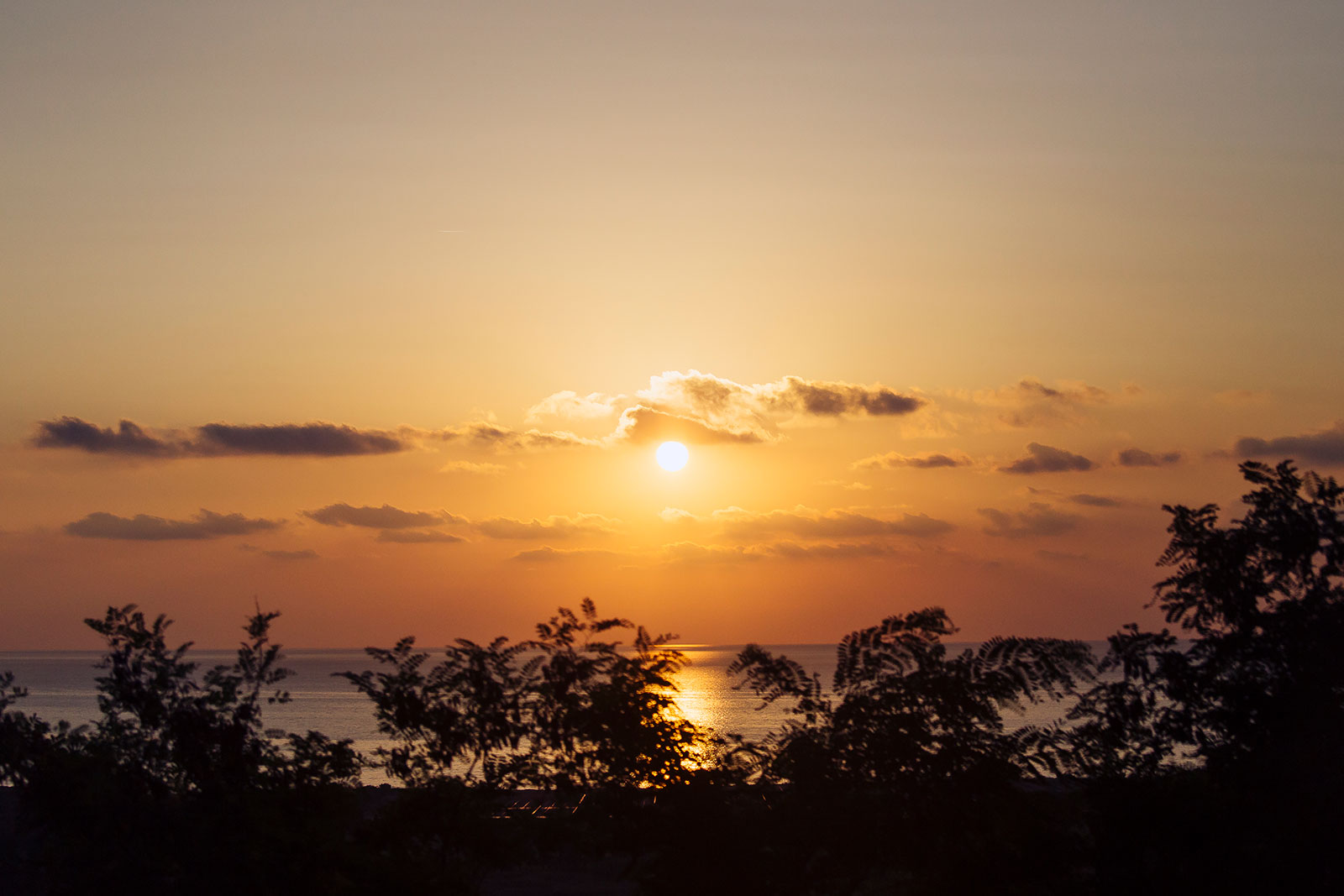
In Calabria there are two dawns and two sunsets: the sun rises over the Ionian Sea and over the Tyrrhenian Sea, and the water is made of two seas and of the fiumare. Geography is what shapes history. And it is from here that we must begin. 
Politics – which is a fundamental component in triggering architectural processes – must detach itself from models that do not work and embrace the regenerative capacity inherent in territories.
Nik Spatari, an internationally renowned artist and recently deceased, founder of Musaba, the art park in Mammola, spoke of the “archaic future” of Calabria – an idea that is less visionary and more deeply rooted in reality. 
I wish greater fortune to this my, and our, ultramediterranean Calabria”.
With Nik Spatari.


medinv-journal_calabria-27.jpg

A GIANT LOOKING OUT TOWARD THE SEA AND THE PLAIN BEHIND IT: GIOIA TAURO, A UNIQUE PLACE DIVIDED IN TWO, EEMBODYING AND REFLECTING THE DESTINY OF A SOUTH SHAPED BY ILLOGICAL SEPARATIONS. A CONDITION THAT ARCHITECTURE CAN TRANSFORM with Giovanni Multari

Giovanni Multari, architect and professor at University of Naples Federico II, believes that regeneration should be a program implemented through small steps, relying on alternative solutions: if the Bridge is not built, let’s immediately redevelop Villa San Giovanni. If industry is not working, let’s invest everything in agri-“culture”.

Invisible Mediterranean(s) is dialogue, comparison, and investigation. It is a journey and a revelation of the invisible dimensions of Sicily and Calabria. It is all of this, but above all it is a way to recognize and reaffirm the strong identity of shy places seeking a sustainable synchronicity with contemporary time.
The Mediterranean is a vast theme belonging to many cultures, marked by different geographies and united by ‘invisible’ aspects, contradictions, and harmonies. The Mediterranean of the Strait is a hidden and reserved place, despite still being a major crossroads and a transnational hub.
At the heart of this Mediterranean, of the South, Rosarno, the plain, and the port of Gioia Tauro form an extraordinary aggregation of masterful visual and olfactory euphonies, together with striking dissonances and urban distress.
Gioia Tauro is a geometric center, but also a generator of economic and political meanings. A place of failed strategies and missed opportunities.
The Port of Gioia Tauro is a giant facing only toward the sea, turning its back on the land because it generates little local impact, is self-sufficient in its function and organization, and is more inclined to look toward the Suez Canal or Strait of Gibraltar than toward its own plain.
Expanding the gaze outward, the richness of extraordinary places immediately emerges – places that have always nourished Calabria. A predominantly agricultural world, whose Calabrian environmental context makes it fertile ground for an evolution that can positively intertwine with architecture.

In Calabria and throughout the South, architecture takes on the meaning of care for the land and for communities; it becomes agri-culture.
We must invest in the traditions we have, enhance them, and make them known: recent pandemic events have confirmed Calabria’s capacity to be an extraordinary reservoir of energy and have highlighted that the region can be self-sufficient.
Infrastructure difficulties still exist, but we are working on them step by step: for example, our mountains are no longer inaccessible. The Club Alpino Italiano has mapped most of the trails and opened the way to a form of tourism that is passionate and respectful of places.
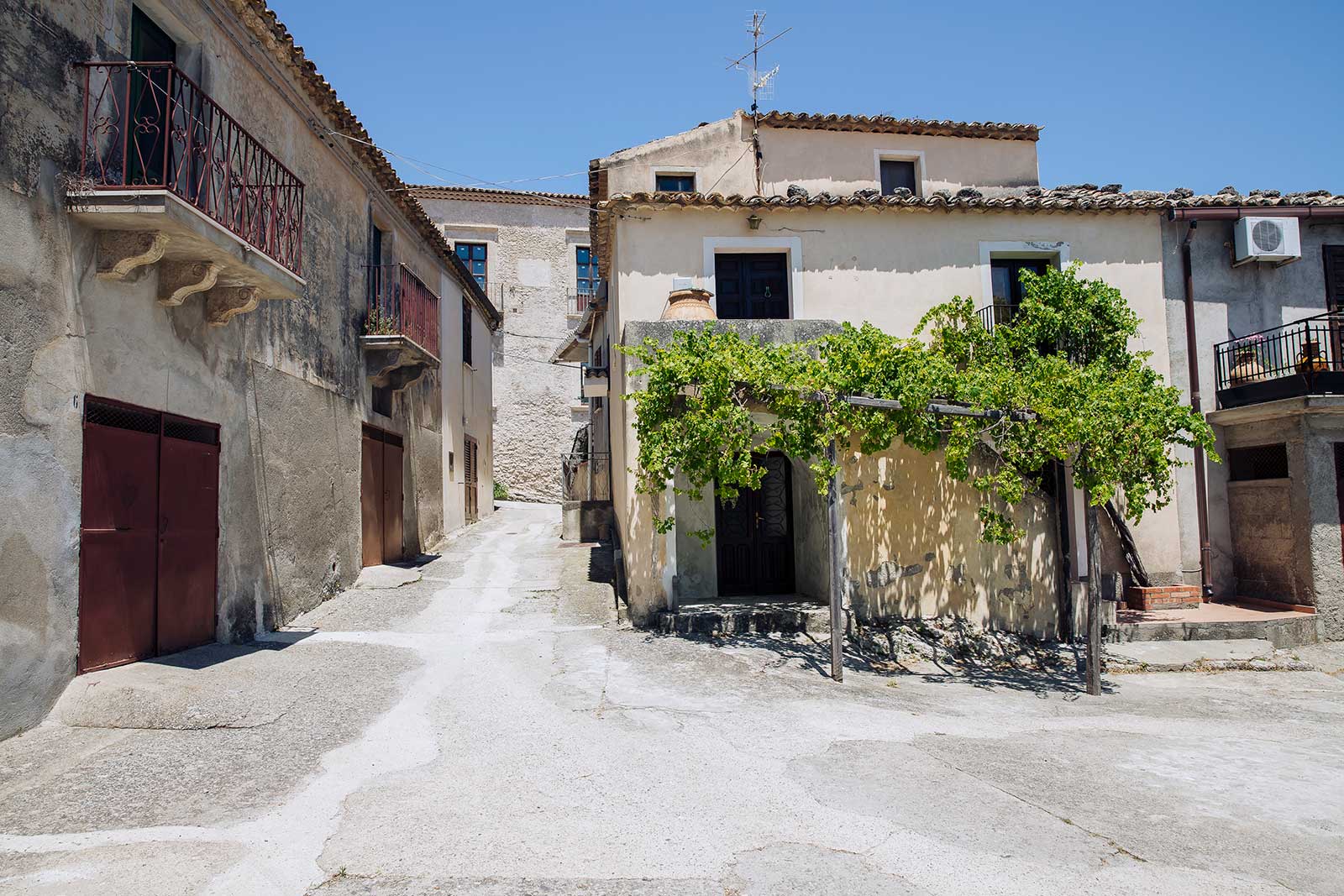
In these mountains lie areas only partially shaped by human activity, revealing an authentic heritage of culture and traditions. It is a unique monumental reality, that of the Sila mountain range, which contrasts with the coastline – a threshold element of the Mediterranean – where design is directed toward the essential themes of ecology and the environment.
In this unusual summer, the first phase of coexistence with coronavirus, Calabria experienced a moment of great redemption, lived across its entire territory, visited by tourists from all over Italy and even by some European visitors. A sign of attention, appreciation, a first step toward taking – by right – a place within a European geography, also through tourism.

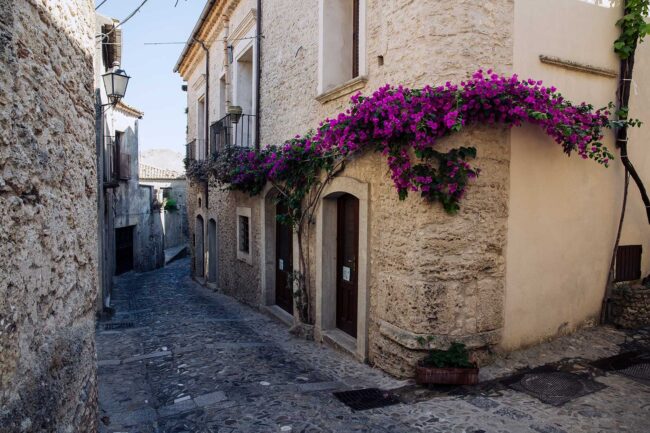
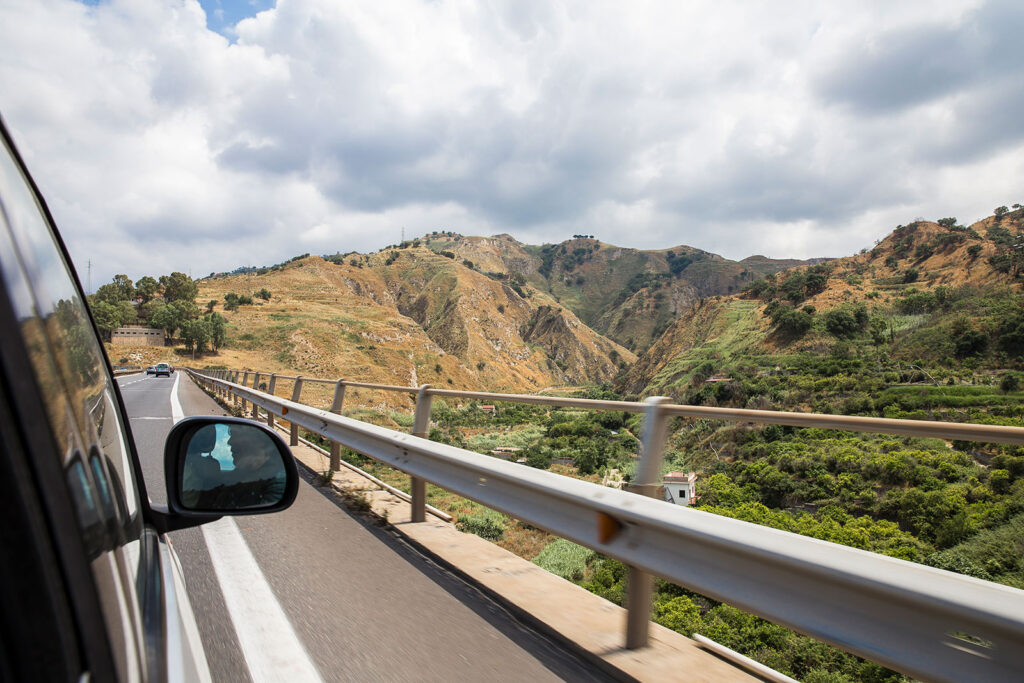
Photo by Stefano Anzini.
Where do we go after tourism?
Urban regeneration processes are not only made of large-scale transformations. Alongside major works – complex and difficult to implement – there is a small, continuous effort that also reaches the less visible territorial fringes and opens up unknown cultural and physical channels of communication.
We already have an infrastructure system in place that works, and it must be integrated with what is still missing.
The Ionian backbone suffers more, while the Tyrrhenian one is very dynamic, and from these different speeds of places emerges an unusual beauty, the awareness of a diachronic condition that generates positive evolutions out of contradiction: Paola, Crotone, Lamezia Terme, Catanzaro, Reggio Calabria.
There are territorial conditions that can be improved without major transformations, regenerating from the ground up and involving communities and citizens.

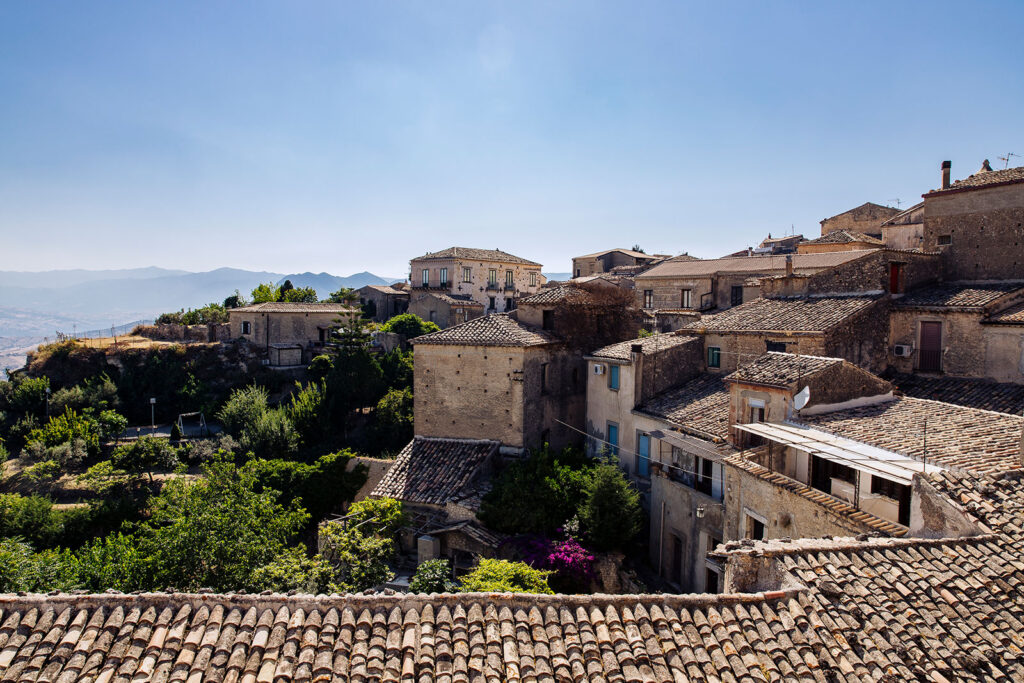
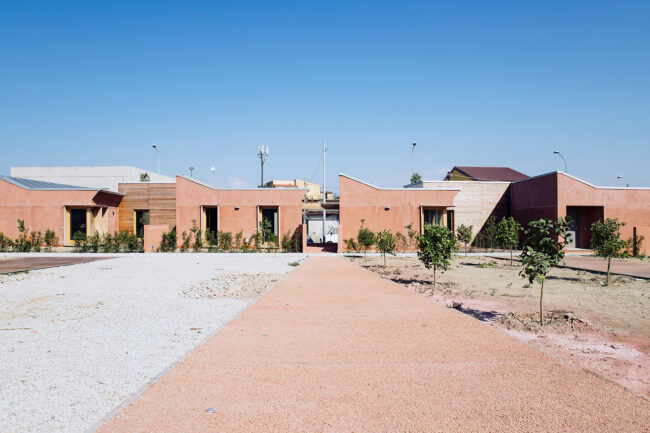
Photo by Stefano Anzini.

Let’s take a step back: how do the different “souls” of the same territory coexist?
Sometimes they are separate, sometimes they intersect. The Port of Gioia Tauro should be better connected with the plain. And if the best industry in Calabria is agriculture, then the agricultural system must be highlighted and enhanced, from cultivation to forestry, considering that it generates a significant economic impact, with exports across Europe.
But above all, precisely in order to reconcile these different identities, we must never stop and proceed in small steps: if the Strait Bridge is not built, let’s redevelop Villa San Giovanni, equipping it as a place of transit, imagining a large marina, and replicating the same program in Messina, to improve the efficiency of the two gateways.
Before thinking about new projects, we should survey what already exists: abandoned places and unfinished construction sites.
Let’s create a table of people who live in the communities; we do not need prefabricated solutions imposed from above.
Let’s involve a network of local businesses, breaking away from a system governed by patronage politics that has damaged Italy as a whole and especially the South.

medinv-journal_calabria-8.jpg

THE INFRASTRUCTURAL GAP GENERATES A CULTURAL GAP. THE DESIGN NARRATIVE STOPS, THE PERSPECTIVE CLOSES. CONNECTION – BETWEEN CLABRIA AND SICILY, BETWEEN THE IONIAN COAST AND THE TYRRHENIAN COAST – IS THE ONLY WAY TO GO BEYOND THE LIMIT with Francesco Messina

Francesco Messina, architect and contract lecturer at the University of Ferrara, addresses the concept of “limit”: the limits of cultural policy, of environmental policy, and of an attitude of self-imitation that prevents major transformation in the extraordinary space between Sicily and Calabria.

Invisible Mediterranean(s) is a narrative that makes it possible to discover territories that would otherwise remain in the background. Above all, it is a form of ‘proof of existence’., because without knowledge, storytelling, and representation, places and landscapes would not exist beyond their physical boundaries. The Journeys Across the Strait have the merit of going beyond the limit of invisibility.
The limit is the most serious problem of our territories: the Strait of Messina has a geographical and political specificity, a point of tension between the island and mainland dimensions of Italy, a large water space where the distance between the two shores is ‘dialectically’ variable. The journey becomes a syncrasis between these cultures – Sicilian and Calabrian – which find in the Strait a unique form of synthesis and propulsive energy, something that concerns the entire Italian South.
Landscapes are revealed, places are identified, and their knowledge is amplified, extending it to the entire local community and to Italy, in a global expansion where, finally, the limit is broken down.
Invisibility is a limit linked to the difficulty of physical connections between places, a condition that feeds and perpetuates itself through the constraints imposed by a culture of conservation which, in a distorted cognitive process, overlaps with certain environmental policies.
Thus, a geographical limit is transformed into a major political limit that discourages development projects and encourages the abandonment of territories sorrounded by increasingly high mental walls.
All levels of infrastructure are missing, starting from the physical one – and I am not referring only to exceptional engineering works such as bridges and viaducts, but also to basic roads.
In Sicily there is greater sensitivity; in Calabria, the two coasts – Ionian and Tyrrhenian – do not communicate with each other.
The revival of Calabria depends on these connection nodes between east and west, and between the interior, the mountains, and the coasts.
Architecture must intersect with infrastructure projects, acting on the territory to bring out its value and transform it into a driver for tourism flows.

Photo by Stefano Anzini

Tourism is a key element for places with unique environmental characteristics. But architecture has the responsibility to look toward the everyday life of a territory …
A country’s strategy can coordinated through architecture, which brings together, within an overall vision, the regeneration of places without allowing certain functions to prevail at the expense of others, and without creating single “vocations”.
Calabria region, in particular, must restart from architecture because it is dense with contradictions; it has been scarred by illegal construction that has continued, unpunished, for years. Architecture recognizes beauty everywhere, even where the “ordinary” eye sees only ugliness, and design is the best tool for redemption.
Redemption and regeneration feed one another, creating places for social life, public and accessible spaces. And precisely the lack of places where people can gather, engage, and find orientation is another serious limitation for communities. On the part of central government, there is a total lack of attention to real needs, and even local politics struggles to understand the true priorities.

Do decision-making and operational processes seem slower in Southern Italy than elsewhere? Is there a different sense of time in Calabria and Sicily?
Contrary to this common perception, I distance myself from the cliché of the “slow time” of the South: time is the same in both the North and the South. The difference is that in the South, Time expands in order to settle, to be absorbed, and metabolized. In the unique space between Sicily and Calabria, there is no such thing as “disposable” time – a consumable kind of time that leaves no trace of reflection or growth. In the South, Time always leaves something behind.

Photo by Stefano Anzini

medinv-journal_calabria-25.jpg

VILLAGES AND LANDSCAPES SPEAK OF CALABRIA. BUT IT IS IMMATERIALITY AND SUSPENSION THAT CONSTITUTE ITS PERFECT NARRATIVE EPIPHANY with Michelangelo Pugliese

Unexpected are the reflections of Michelangelo Pugliese, architect and landscape designer, professor at the University of Naples Federico II: mutation as a stable element of the landscape, and the search for beauty everywhere – even in what is ‘ugly’

Is the South a territory?
Michelangelo Pugliese is not particularly fond of the world ‘territory’, arguing that it evokes a ‘1970s flavor’ and an overly technical, urban-planning dimension. He prefers to use the term ‘landscape’. Why?

Because, in his view, ‘territory’ tends to frame space as something primarily administered, measured, and governed through planning categories – roads, zoning, infrastructure, administrative boundaries. It carries a bureaucratic and functionalist imprint that became especially strong in post-1960s and 1970s planning culture. ‘Landscape’, instead, shifts the focus. It is not just a container of functions, but a lived and perceived space: a synthesis of natural forms, built environments, memory, perception, and everyday practices. It allows for ambiguity, change, and even contradiction – including abandonment, transformation, and informal uses – without reducing everything to a planning problem to be solved. In that sense, speaking of ‘landscape’ rather territory is also a way of resisting a purely technical or top-down gaze. It opens the possibility of reading the South not only as something to be organized, but as something already meaningful, already narrated, and constantly evolving – even in its fragilities.

The relationship between these three elements is in continuous evolution, and this immediately highlights how the expression ‘landscape restoration’ is, in itself, a contradiction in terms.
Mutation is the primary characteristic of landscape.
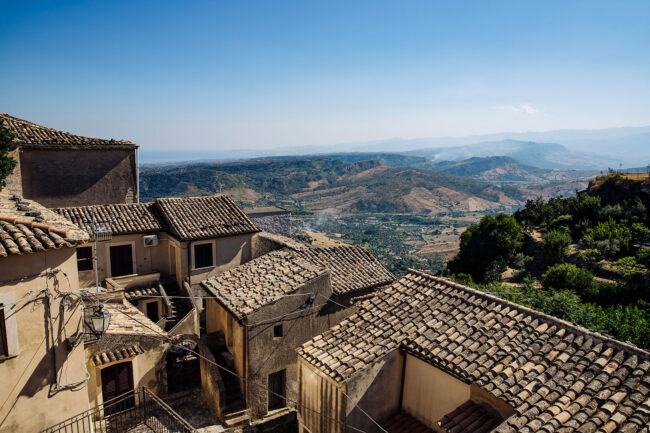
Calabria is a landscape that cannot be trivialized through opportunistic interpretations tied to villages, coastal areas, or mountains. Starting with villages, we are not dealing with idyllic situations, as the term itself often seems to suggest regardless of context.
In Calabria there is no widespread desire to ‘return to the villages’; this is more a media distortion or an exercise in balancing architecture and marketing narratives.
Often, villages are not only abandoned places, but also damaged by an unforgiving and often ugly form of construction – acts of architectural violence that have unfortunately sedimented over time.
The complexity of reinterpreting them also involves the theme of dwelling, which contemporary society has profoundly transformed.
As well taught in Spanish schools of architecture, the design theme is not singular but must be declared and adapted according to places and situations.
Thus, today, living in a village is different from living in a small town. The actions required must be appropriate and coherent with the historical dimension, the recent past, and future perspectives.
Certainly, the only thing that cannot be done is simply ‘returning’ as if going back to the village had, in itself, a healing or redemptive value.
If ways of living have changed, and this transformation must be supported through design actions, then with equal care we must avoid trivializing the process of updating, or turning interventions into mere salone exercises. A propositive example of a well-conceived project is Farm Cultural Park, near Agrigento, which has enhanced a degraded and abandoned place through cultural regeneration.

Photo by Stefano Anzini.

The example of Favara is remarkable, but its starting point already had some advantages: the Moorish-styly courtyards in Favara’s historic centre, and its proximity to Agrigento …  

Villages to be restored do not all start from the same conditions of fascinating abandonment and decay wrapped in brambles that conceal extraordinary beauty.
However, the intensity of a suspended soul exist in all centres that were once inhabited: a hidden soul, sometimes deeply concealed by ‘uglyness’. I also believe it is an advantage to work on places where beauty is more hidden. In such cases, research can free itself from the constraints of the Soprintendenza Archeologia, Belle Arti e Paesaggio, but above all from certain cultural approaches that do not allow for the new, or take into account the unpredictability of a design thinking shaped by landscape and communities.

Our project, Invisible Mediterranean(s), has the unique merit of revealing the beauty behind ugliness, without fearing to engage with visions closer to a scenario of desolation that to the enchanted forest of Sleeping Beauty.
All of this is the authentic contemporary South: a South that coexists with ugliness and, in turn, coexists with magnificent landscapes, tongues of sea and light. It is a reality that must be valued and cannot be ignored, because it is within it that communities live – memory of the past and energy for the future, the true strength of the South.
It is the immaterial dimension that filters the beauty of landscapes and villages, making everything clear and more legible, beyond the stereotype of the postcard image.
The architect’s work thus becomes more difficult, as it requires the reconstruction of the immaterial dimension of territories, often suffocated by labels and narratives that have distorted their soul.

In this balance between needs and desires, time plays an essential role.
The time of South is different, but it is not slower, as is often said. It is a non-linear time, made of compressions and dilations: at times it condenses rapidly, at others it settles. Actions combine according to this temporal balance, from which design action emerges.
More than ever today, architecture must step down from the pedestal, be courageous, take risks, and accept even the possibility of error.

Photo by Stefano Anzini.

medinv-journal_calabria-9.jpg

THE STRAIT BRIDGE AND THE MUSEUM OF THE SEA BY ZAHA HADID COULD TRANSFORM SOUTHERN ITALY INTO A DYNAMIC SOUTHERN EUROPE AND A DRIVING NORTHERN HUB FOR AFRICA AND THE EAST with Salvatore Vermiglio

It is not a provocation, according to Salvatore Vermiglio: the invisible reveals itself through a comprehensive strategy of emancipation from outdated and worn-out models. The South, and Calabria region in particular, are vibrant and full of energy.

The emerging – albeit slow – process of restoring architecture to its role as an urban and social driving force, as a means of strengthening communities and as an engine for collective progress, represents and extraordinary opportunity for the entire country, for our South, and for supporting, guiding, and assisting both national and local politics.
The questions and reflections awakened by the pandemic have, as an initial reaction, turned the spotlight onto Italy’s beautiful yet invisible places. To make our places truly accessible and enjoyable, architecture and politics must work together – and quickly: without roads without infrastructure, these invisible places cannot be reached.

Building the bridge across the Strait or the tunnel beneath it (interchangeable in terms of connection, though certainly not in terms of architecture, engineering, and impact) is an important choice for opening up to the world and to Italy a closed-off territory that would undoubtedly undergo profound transformation, altering geographical, environmental, and socio-economic balances. Something would be lost (a great deal, perhaps?), but much would also be gained. Our South would become a strong South, with a decisive voice on the economic and political stage – a new hub between Africa, the East, and Europe. An infrastructure network serving the hypothetical bridge would generate economic value and unlock the cultural and tourism potential of our territories. Architecture, fundamental in this process, would have the task of guiding a conurbation protected from degrading physical contamination – in terms of construction, urban planning, and infrastructure.

In summary and simplifying the issue, the point is that if the bridge is not built, the essential infrastructure will not be developed – both those within the regions and those connecting them to Rome and the rest of Italy. The urgency of the bridge, together with a coordinated and parallel project linking the bridge and infrastructure development, means transforming Sicily and Calabria into Europe. Conversely, stepping back from the commitment to build the bridge would mean remaining stagnant,. anchored to that prefabricated vision of the South, while denying its European and global potential.

Photo by Stefano Anzini.

Denying the bridge means remaining invisible. The invisibility of a territory is not a protection of its beauty, but rather a detriment to its enhancement and dissemination. A powerful parallel, despite its harshness and discomfort, is the contrast between expansion and contraction. The risk of contraction is extremely high and,. in a global context that tends toward expansion and integration, it increases the danger of permanent exclusion from development processes. To counter contraction, it is essential to direct investments towards schools and both physical and digital infrastructure. Cultural and physical depopulation is a serious form of contraction, and education – together with awareness of the value of the territory – is the only real possibility for reversing the course of abandonment.

How can a pragmatic and operational vision be reconciled with positions of ‘intellectual and protective hesitation’, discreet enhancement, and slow-paced development?
Ours – especially Calabria’s – is an undeserved invisibility. I believe that bringing greater attention to the territory, even through bold and powerful attractions, is a crucial step toward restoring balance between what is visible, what remains invisible yet deserves to be revealed, what can remain invisible (delicate and unique parts of the territory), and even what we may not wish to look at.
Haha Hadid’s project for the Museo del Mare could become such a powerful attraction, beyond the architectural and cultural controversies surrounding it. In this regard, as the Order of Architects, we have committed ourselves to contributing to the public debate, and we have created a synergy with the municipal administration of Reggio Calabria for the realization of the Museo del Mare.

Bringing to light the richness of Reggio Calabria and strengthening the university system so that it can serve as an attractive hub not only for the South, but for all of Europe as well – given the undeniable uniqueness of our heritage – could prove effective, just as it has for other cities, Ferrara for example, also acting as a driving force for urban renewal in the form of a university city, helping to reverse the processes of abandonment and depopulation.

In this vision, villages – no longer isolated entities defined solely by their uniqueness and beauty – could benefit from a network capable of supporting their immense potential. A village is not a consumer product. It makes no sense to speak of villages in a generic and interchangeable way, as a thought Tuscany could be swapped with Liguria, or Liguria with Calabria. In many of our villages there are not even emergency medical services, assuming one can actually reach team. Nor is there fiber-optic internet access, assuming it is even possible to buy groceries without embarking on expeditions that consume an entire day.

What is the operational path to follow?

The first step is to abandon local rivalries between Sicily and Calabria and work together to bring priorities and intervention strategies to the attention of lawmakers. Let us raise our heads again, especially now, after COVID – which, despite the harshness of loss, the severity of illness, and the economic devastation it caused, had the merit of making us aware of how strong the South truly is.
To achieve this, let us begin with architecture, assigning it a strategic coordinating role. We are no longer willing to settle.
Let us dare to make difficult choices. Let us bring architecture and infrastructure together. Let us connect the Ionian coast with the Tyrrhenian coast.
Let us think and act freely, without prejudice.
Let us accelerate.

medinv-journal_sicilia-9.jpg

THE MEDITERRANEAN OF THE STRAIT IS NOT CELEBRATED THROUGH STRIKING MONUMENTAL OR LANDSCAPE EPISODES; IT IS MADE OF FRAGMENTS AND GLANCES with Gaetano Scarcella

Reflections by Gaetano Scarcella, a Sicilian architect active in Messina and Nizza di Sicilia, addressing infrastructure, tourism, and education in relation to globalization

The Mediterraneans are not all the same. Perspectives and conditions change between the Atlantic Mediterranean and the Mediterranean that washes the Tyrrhenian, Ionian, or Adriatic coasts of Italy. Invisible Mediterranean(s) – Journey Across the Strait III – focuses on the strip of sea and the territories between the extreme edge of Calabria and the welcoming, outstretched cusp of Sicily.
This territory is so distinctive that, to truly understand it, one must experience it slowly – walking, lingering along a path made of diverse yet coherent fragments that together generate the uniqueness and rural character of these places. Small villages, terraces, and spaces – those of the Messina area – do not live through spectacular monumental or scenic events. Here, Time transforms from an abstract theme into a material reality measured by the speed at which places and the relationships between them were built.
Within this vision, the village embodies one of its meanings: a settlement, an extension of a settlement, or a way of living connected to the past through its relationship with the land.
Our villages were born to protect communities from medieval pirate raids, within a territorial system based on agricultural connections and the use of water resources.
Construction methods and systems of relationships were conceived according to the climatic conditions of the periods in which they emerged, when dwelling expressed different meanings and needs because domestic life was not yet the central focus of existence. 
This is the primary reason why the destiny of these villages must be understood starting from their present-day relationship with the territory, reconciling it with their historical one. Some villages, because of their landscape, architectural, or historical qualities, now exist in a postcard-like dimension. Yet not everything can adopt the traditional tourism paradigm as its model for development – either because there is no natural vocation for it, or because these places do not wish to transform themselves in that direction. For example, the Ring of Nisi is a circular network of paths connecting the four centers of a valley marked by discreet and unexpected landscapes, abandoned mills, agricultural scenery, and scattered monuments.
It is precisely here that, in recent years, spontaneous movements have emerged with the aim of promoting a quieter, research-oriented form of tourism – one that does not conform to the pre-established mental image shaped by traditional tourism models.
If it makes sense for the revival of a territory – such as the Ionian valleys of the Peloritani Mountains, the first stage of the 2020 journey – to pass also (though not exclusively) through tourism, then it is essential to find the right and respectful interpretative key, because these are still unexplored places.

The meaning attributed to tourism – de-seasonalized and made more ‘cultivated’ – must be calibrated to places not only in functional terms, but also in ways that are coherent with the temperament and vocation of local communities.
If tourism appears to be a spontaneous and straightforward opportunity for revitalizing Southern Italy, development neverthless remains dependent on three fundamental elements of growth: physical infrastructure, educational systems, and digital infrastructure. When speaking of physical infrastructure, we must move beyond the obvious refrain of simply strengthening road and railway connections. Instead, contexts should be carefully analyzed in order to identify solutions that are harmonized with the physical characteristics of each territory. When we speak of physical infrastructure, we are still living in a prehistoric age: in much of Sicily, public transportation is unusable, there is no genuine cycling network, and places of extraordinary charm – such as the Magna Via Francigena – have only been minimally enhanced. Schools, especially in Southern Italy and particularly in this South, must take on the responsibility of transmitting knowledge, awareness, and prime in local places and identities. Finally, digital infrastructure must become a means of projecting Southern Italy outward, connecting it with the rest of the world.

Photo by Stefano Anzini

What design strategies can be implemented to reconcile, for example, infrastructural development with the expansion of tourism?
The approach is, first and foremost, cultural: infrastructure is not meant ‘for others’, for tourists, but rather serves the needs of the territory and its communities, because the primary outcome of good physical infrastructure is the improvement of the quality of life of every individual citizen. This is not about emulating or uncritically importing Northern European or Northern Italian models. Instead, it requires analyzing the organization of local economies and working through their underlying values – including in terms of infrastructure – for example by preserving the identity of agricultural systems and highlighting the biodiversity of the landscape.

The landscape is a unique and unrepeatable product, and it is precisely from this awareness that one can work on the territory by adopting the right interpretative approach and intervening in ways that enhance its value.
Southern Italy may appear as a small and marginal fragment when viewed within the broader framework of globalization, yet its renewal could emerge precisely in opposition to the cultural models of the Anglo-Saxon world, which, in 2020, revealed the profound limitation and inability to replace the verb to consume with the verb to live.
The South could become the counterpoint to ruthless globalization, absorbing only its positive aspects and finally emerging as a truly competitive cultural and territorial model.

Photo by Stefano Anzini

CONTRADICTIONS AND OBJECTIVES: WHY IS THE SOUTHERN ITALIAN MEDITERRANEAN A POOR REGION, EVEN THOUGH WEALTH DEPARTS OR PASSES THROUGH HERE ON ITS WAY TO EUROPE? with Giuseppe Ida

Reflections by Giuseppe Ida, lawyer and mayor of Rosarno, speaking about transshipment, functional integration, and … the South, not just turism

Imagining that the Mediterranean and the South can contribute to the overall balance of the country and of Southern Europe is not an unrealistic dream.

The Mediterranean is a crossroads of cultures; restoring its centrality is a possible goal – indeed, it is the revival of a model already experiences in the past. Certainly, physical infrastructure is the first element that can help rebuild the centrality of Southern Italy. One example is the Port of Gioia Tauro, the third largest in Europe and the largest in Italy for transshipment – the transfer of cargo from one ship to another, usually through unloading in port and reloading. This takes place in hub ports where many shipping routes with different origins and destinations intersect. In the area surrounding the port, the movement of goods and the exchange of culture intersect and integrate.

One immediately perceives the contradiction between the habitual tendency to think of poverty as the harshest expression of Southern Italy, even though in reality it is precisely from our Mediterranean that wealth departs or passes through on its way to Europe.

The strengthening of physical infrastructure could generate lasting local wealth and place our Mediterranean at the center of the European development process, engaging with and balancing other transshipment hubs, for example. This strengthening should arise through a balanced participation of the public sector and private investors. But when strategy and planning are lacking, investments end up being wasted or undermined. This magnificent South, despite having such a highly efficient port, lacks an adequate railway system to transport goods and likewise lacks a road network capable of supporting the port’s expansion by land transport. Infrastructure and culture, in close connection with institutional strategies, are the fundamental pillars of a process aimed at making the South a leading force in Europe.

Today, the meaning of the South is almost entirely equated with tourism, but can tourism alone make it a leading force in Europe? And what kind of tourism are we talking about? What is the twenty-year vision for the Mediterranean?

For many parts of Southern Italy, tourism still remains an unrealized potential, and this consideration immediately brings us back to the previous issue: the development of what is still an underdeveloped tourism sector also depends on the growth of infrastructure and of the territory’s economy as a whole. It is difficult to imagine achieving results in the short term. Added to this is the fact that, in Calabria, youth unemployment has reached extremely high levels, despite the existence of real employment potential. Responsibility lies equally with regional and central political leadership that has been profoundly inattentive and has failed to allow these untapped opportunities to develop.

Certainly, Calabria can restart from its port system. During the lockdown period, Italian ports recorded a 30% decrease in traffic. Our port of Gioia Tauro, however, recorded a 40% increase, because goods destined for all of Southern Europe depart from here. Beyond this, stepping away from a strictly Calabrian and Italian perspective, it is essential to observe that the European vision of the entire Mediterranean is shaped through its ports.

A topic with limited media appeal and considerable complexity, seaports require cross-disciplinary expertise in logistics, technology, economics, and international relations. Insufficient attention is given to the value of ports, and the surrounding territories fail to connect with the broader economy. This also occurs in other Mediterranean countries – the so-called PIGS (Spain, Italy, Greece, and Portugal) – all countries considered key drivers of Europe’s growth.

In reality, precisely because of the unexpressed yet concrete and quickly activatable potential of these territories, if Europe wanted to become stronger and expand its capacity for inclusion, translating it into development, it should invest more in these regions.

Today, the Mediterranean and Southern Europe are not seen as places of development nor as crossroads of culture, because multiculturalism that is poorly managed and lacking integration turns into poverty. And, by ‘betraying’ its potential for opportunity, it becomes a burden to be carried. A vicious circle is triggered, whose dramatic outcome is the lack of investment in Europe’s periphery, precisely because it is seen as non-productive…a dead weight. In this vision, negativity spreads in concentric waves that affect the villages of which Calabria is so rich – places of history and culture that, in just a few decades, have been transformed into realities of sadness and depopulation. 

The regional administration of Calabria has committed itself to a policy of enhancing the villages that preserve our elderly, our customs, that intangible evanescence which is perpetuated through belonging to the territory. However, for now, except in a few exceptional cases, it remains a denied form of intangible heritage. In other contexts, for example, transhumance – the traditional practice of seasonal livestock migration – has been inscribed on the UNESCO Representative List of the Intangible Cultural Heritage of Humanity. The enhancement of villages falls within a strategic tourism plan that centralizes infrastructure, not as alienation, but as a form of valorization of the territory.

Photo by Stefano Anzini

Photo by Stefano Anzini