


Ph. ©fotoarchitetto/RiGymnasium, ©S. Anzini
THE EXHIBITION DESIGN:
REINVENTING FORTE BATTERIA SIACCI
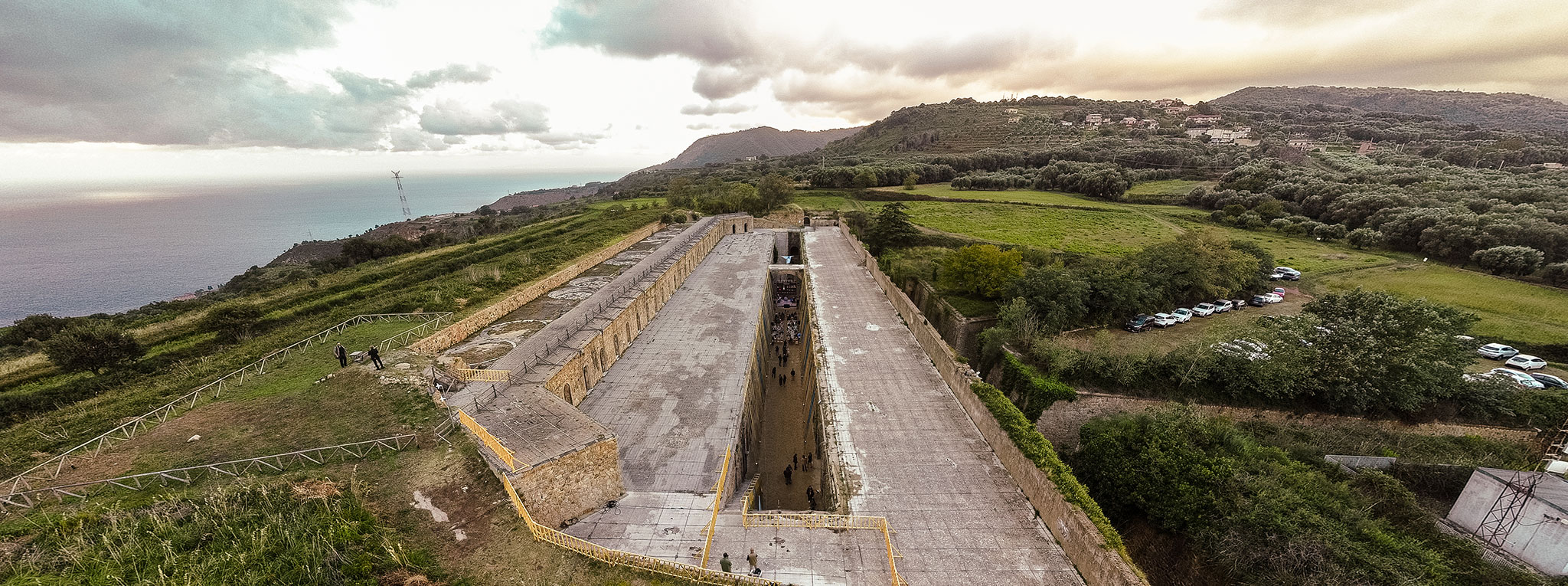
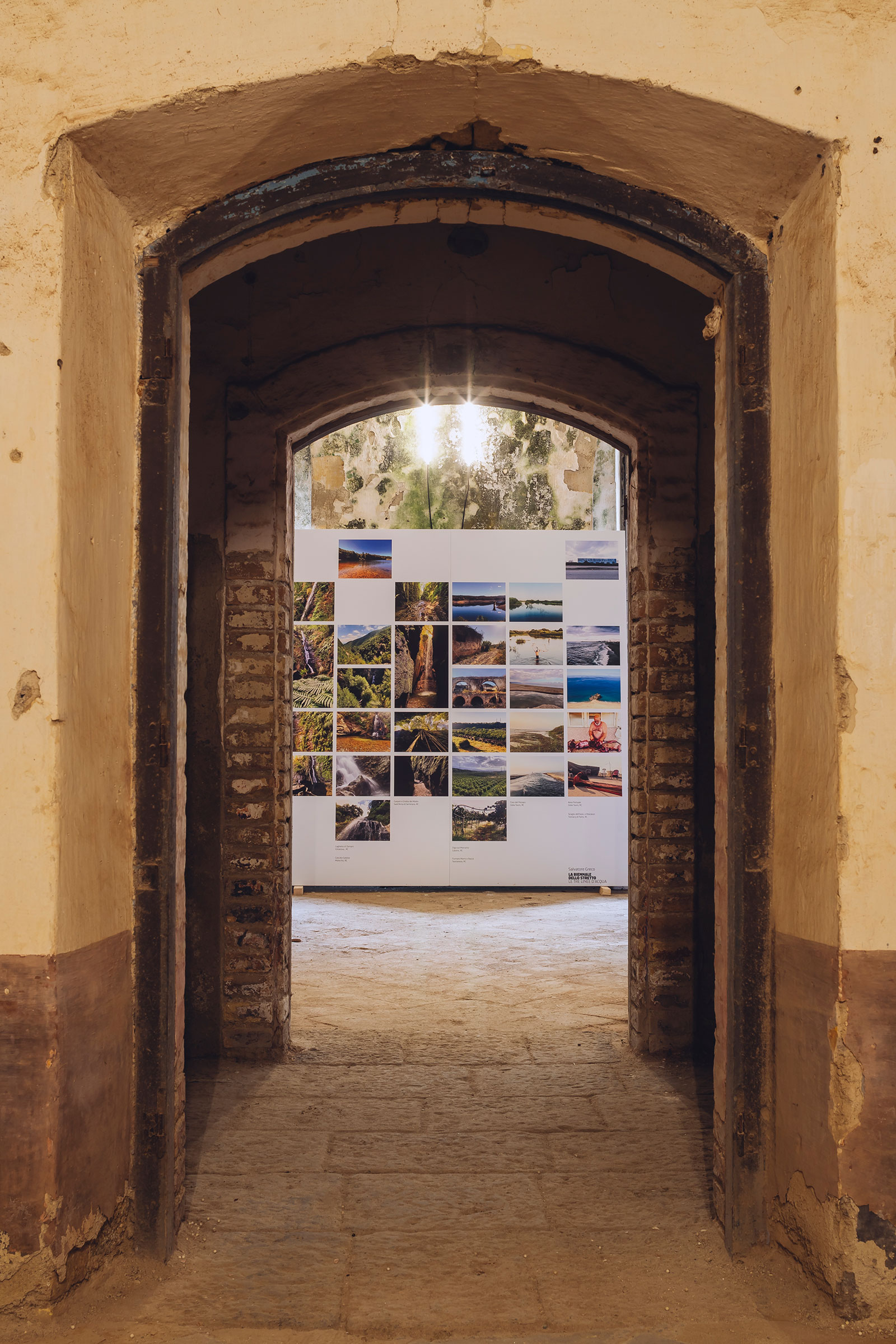
The exhibition design of the Biennale dello Stretto is not simply a project house works of art and architecture, but the reinvention of a place.
An ephemeral yet powerful intervention that restores meaning, identity, and lasting dignity to Forte Batteria Siacci.
A few carefully considered actions are enough to stage it, to make it known through the sharing of thoughts, ideas, and emotions, and to lay the groundwork for its return to life – so that after this Biennale there may be a hundred, a thousand more occasions.
The sand covering the floor of the “entrance nave” levels out the uneven original stone paving from 1888 – the year the Fort was completed – and creates an invitation to share the place.
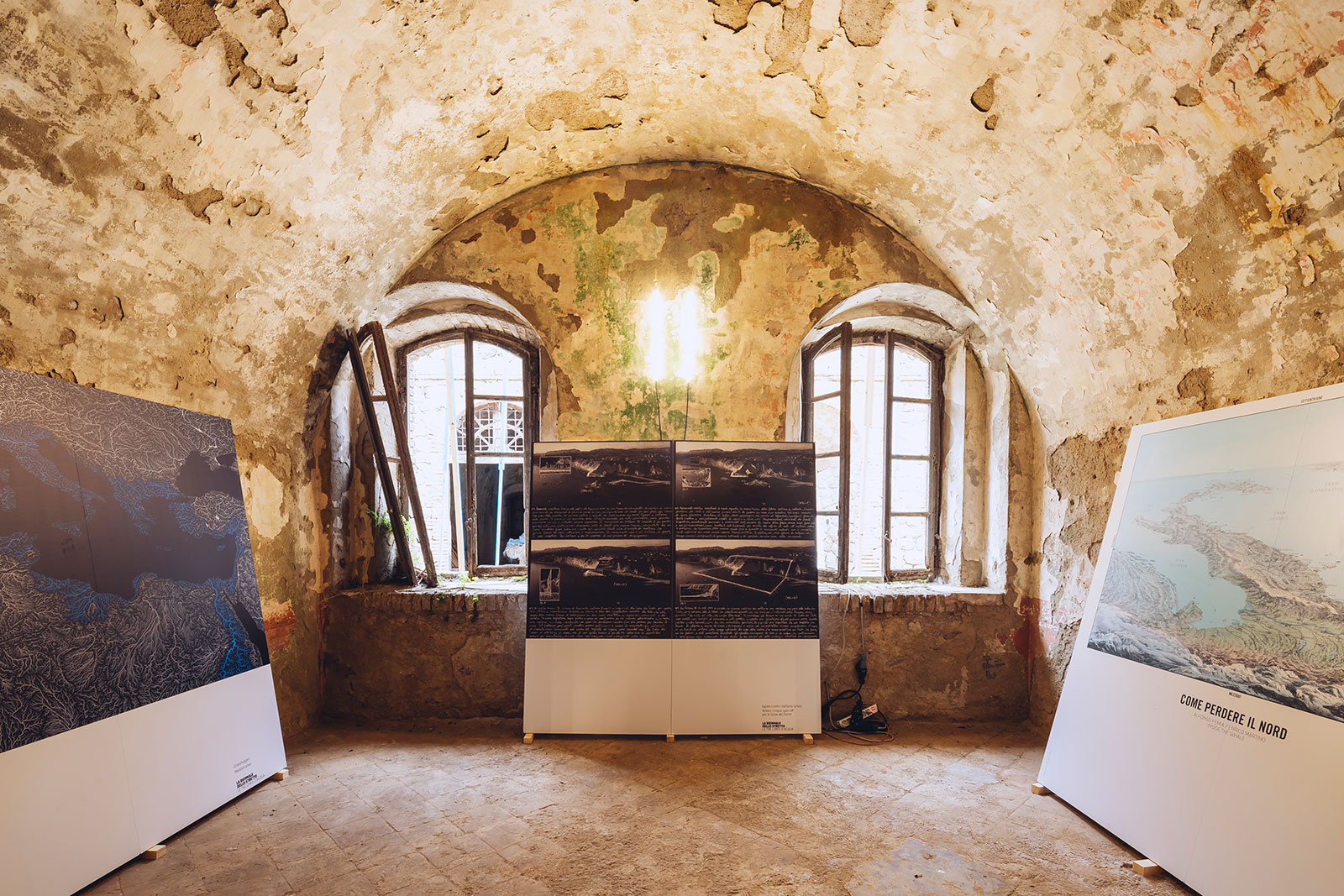
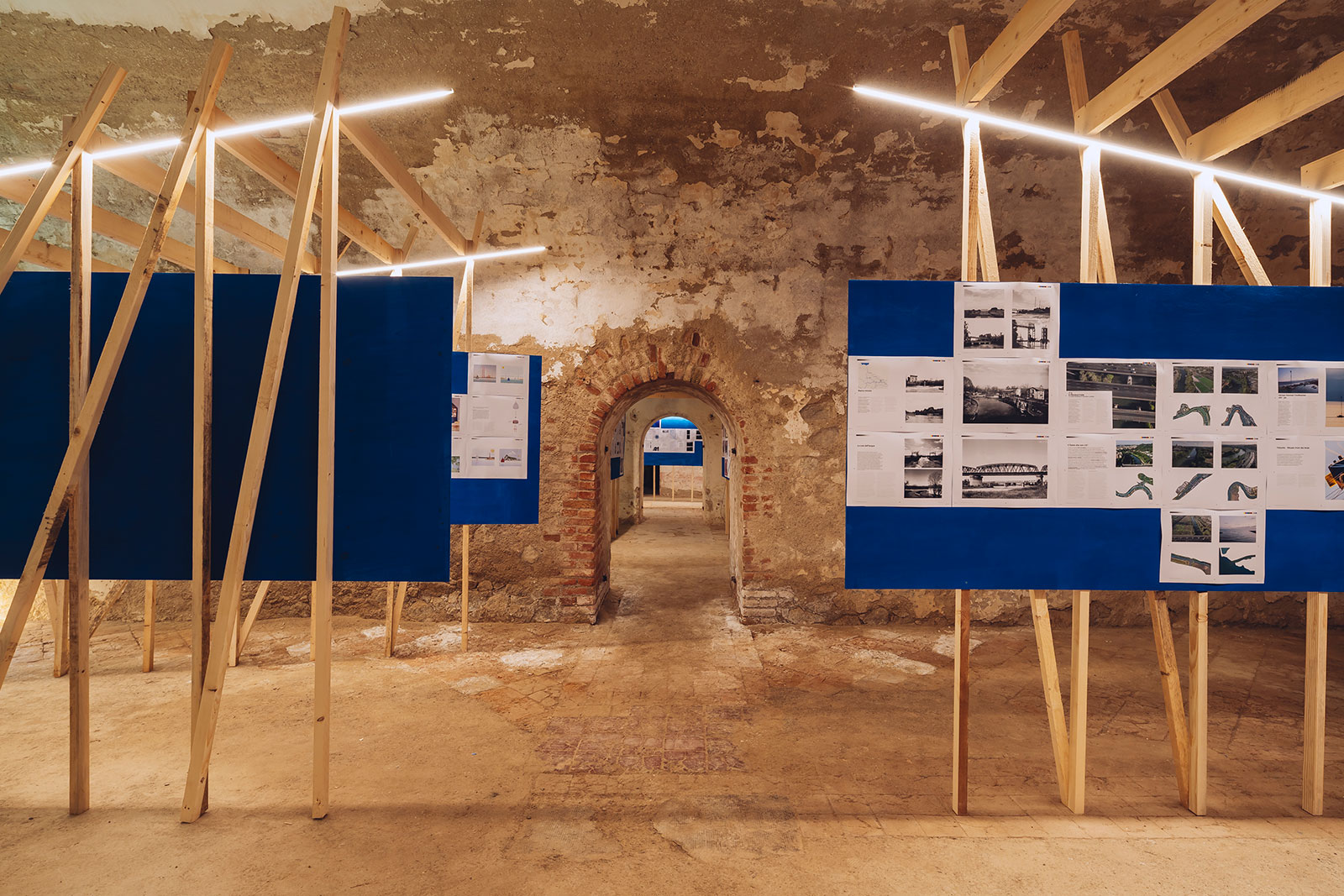
The imposing corridor takes on the scale of a dry dock, focusing attention on a single perspective – that of reflection and dialogue (the stage for talks) – before dispersing into rooms dedicated to the exhibition of projects gathered through the international Call to Action, the Challenge to Action aimed at architects under 35, and the works of artists.
Forte Batteria Siacci becomes a spontaneous promenade through time. Through this transformed space, it takes on a secular monumentality: its new dimension is celebrated through its civic function.
If it is true that places exist thanks to the people who inhabit them, then Forte Batteria Siacci will also be remembered for the Biennale dello Stretto and for the people who brought it to life – because this is now its memory.
THE ART INSTALLATIONS AT THE BIENNALE
Art has been a major protagonist at the Biennale dello Stretto.
Running until December, the exhibition of art, architecture, and photography at Forte Batteria Siacci, in Campo Calabro, is open on weekends, and on Thursday mornings for organized groups and schools.
The Biennale dello Stretto, conceived by Alfonso Femia and curated by Francesca Moraci and Alfonso Femia opened on September 30, 2022.
Promoted by the Order of Architects of Reggio Calabria, the Metropolitan Cities of Reggio Calabria and Messina, and in collaboration with the Order of Architects of Messina, the event achieved remarkable success thanks to its cultural diversity, the richness of ideas presented, and the international guests who took part in the five days of talks, held through October 4, 2022.
The relationship between art and palce is especially strong: the reinvented Fort offers, in its individual rooms, an intimate dimension where the relationship between artist and work, and between the work and the public, unfolded.
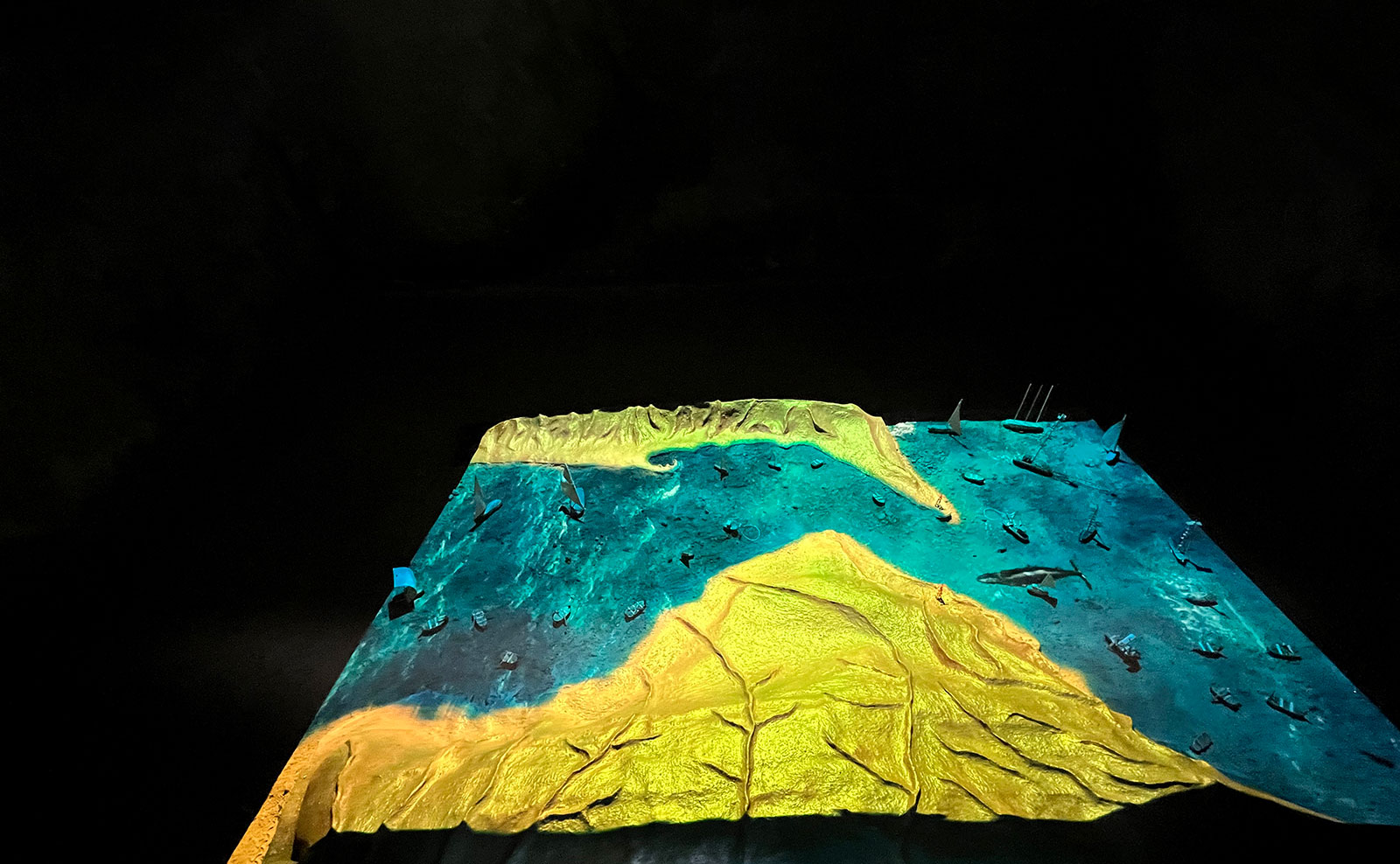
In this regenerated space, artists have staged the theme of the Biennale– the three water lines. The extraordinary setting of the Fort provides the opportunity to explore the balance between human presence and nature. Water becomes, at once, material, landscape, and exploration.
Angela Pellicanò of Techne Contemporary Art stated “The artists of the Strait suffer from limited national and international exposure, despite their extraordinary potential, which is also tied to the unique characteristics of these places. The Biennale dello Stretto is physically rooted in this territory, yet it looks beyond its borders toward international horizons. The very theme of water reflects the intention to go far beyond local contexts, identifying a collective, necessary, and urgent value of storytelling and respect. In this representation, the Strait is not a geographical dimension, but a place of the soul”.
Among the installations on display, “Forme armoniche delle maree” by Technelab synthesizes the themes of time and water. The alternation of high and low tide at a specific point in the Strait has been simulated in a column filled with Mediterranean water. The movement is accelerated and, in relation to the other works in the room, perception oscillates between vision and rationality.
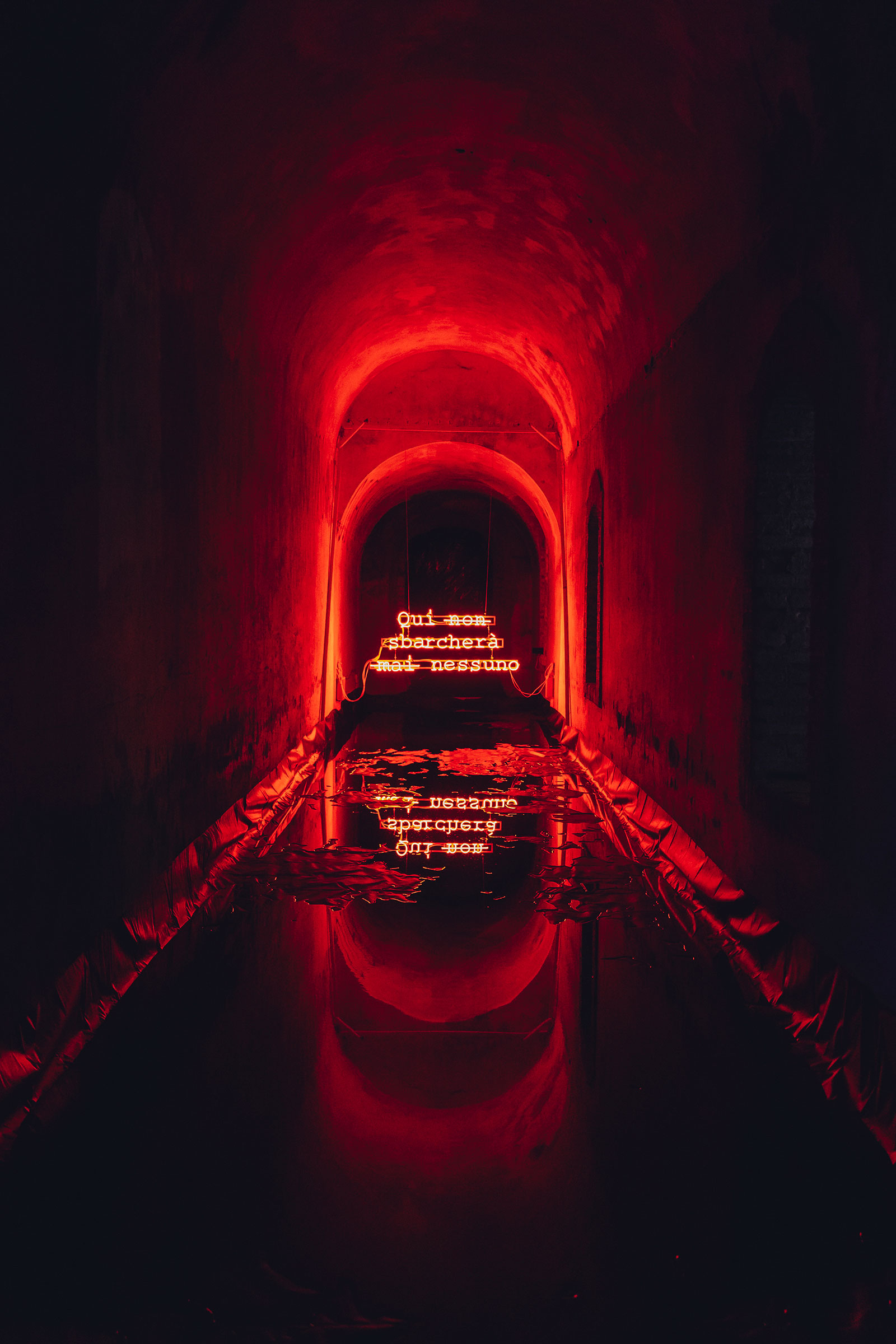
The work by Ninni Donato of Technelab on the political meaning of water is masterful. The Mediterranean is a place of landings, a place of death – a line of water that is also a cemetery. A neon installation, suspended from the vault of the Fort’s longitudinal service corridor, expresses both the denial of hospitality and, in its new interpretation, the possibility of welcome. It consists of a slender glass tube shaped into the letters of a statement made by Benito Mussolini during his speech in Palermo in August 1937.
“Qui non sbarcherà mai nessuno”
The removal of adverbs of negation and time becomes a powerful representation of how “political water” can be both boundary and connection, inclusion and exclusion. In the background, an electronic voice recites a list of 40,000 names of men who did not make it.
Water, the work by Francesco Scialò of Technelab, focusing on the theme of water exploitation – bottling, packaging, and polluting plastic– reframed through an inverse narrative, a return to the sources. This is expressed not only as a form of denunciation, but also by acknowledging different shades of thought.
The starting point was the discovery of a mineral water bottle cap in the forstes of Aspromonte. Why drink bottled mineral water in a place where there are so many sources of safe, fresh water? The cap triggered turbulent questions, later distilled into drawings, photographs, paintings, and diagrams made with discarded materials, all in white.
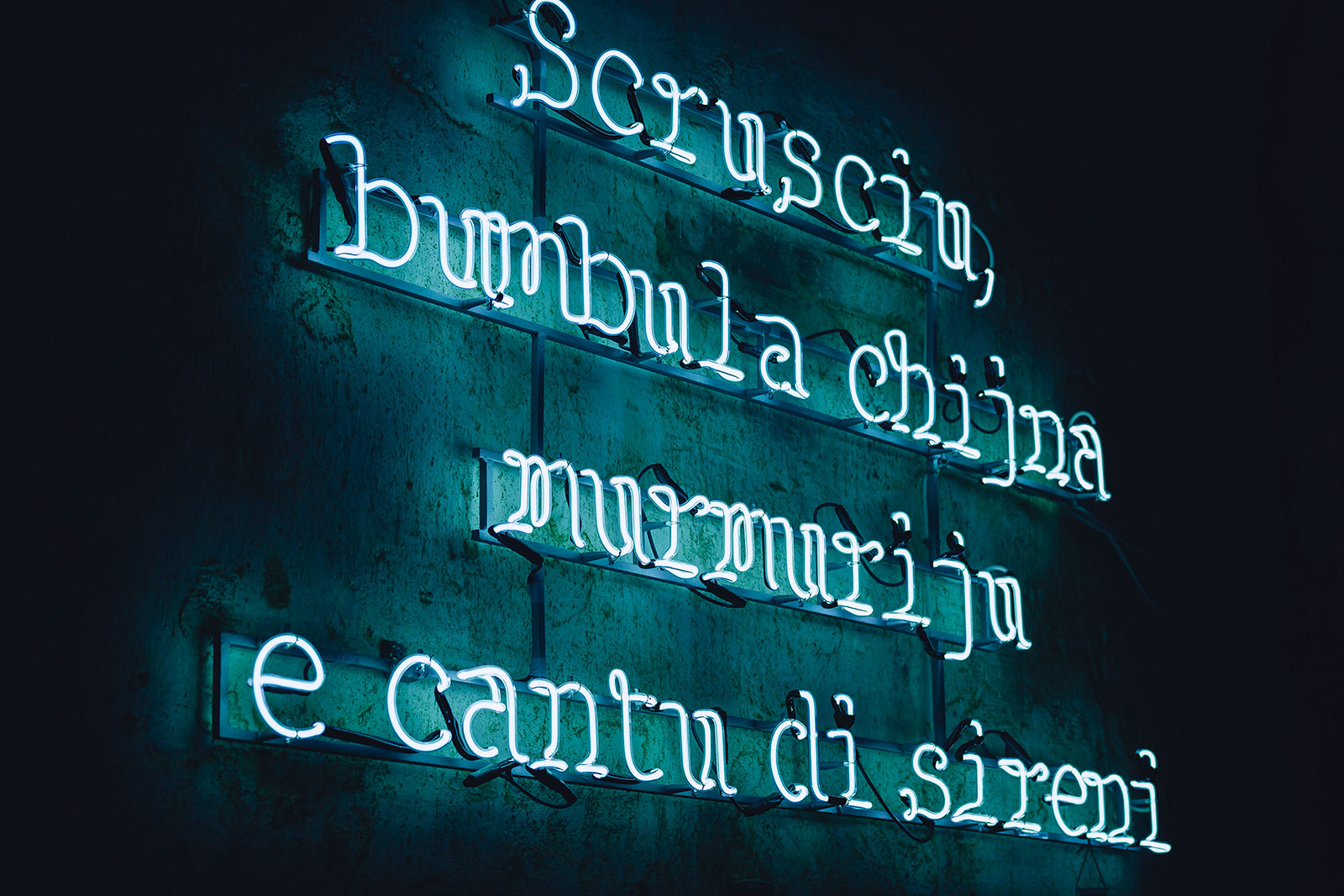
A parallel dimension, decontexualized from reality yet still reflecting its tensions and conditions, emerges in one of Gianni Brandolino‘s works, “Non ricordo più il mio sogno”: water dispensers attached to the vaults like chandeliers, water spreading as if it were light, fountains opening onto the enchantment of sirens. On a slightly inclined surface, almost stimulating the natural space between sand and the backwash of waves, water expands through a guided path, generating an (human) absurd nature, drawn into vortices and confronted with atavistic fears. The work references gender identity; sexual imagery confirms human fragilities. Silent taps give way to virility, and this energy sinks into an aquarium of zoomorphic figures. A trasgressive and poetic act made of vulnerable worlds and abysses that chase one another in order to recognize and merge with each other.
The myths of the Strait have been a rich source of inspiration: the vibrant presences in the nave of the Fort – textile works by Lucia Bubilda Nanni – refer to Mediterranean narratives, including a portrait of Mary of Egypt, the Egyptian nun and hermit; Aquarium, a large textile that intertwines the diverse migration routes of the fish; and finally Scylla, a figure immersed in water, born of striking beauty and transformed into a sea monster.
Nicola Tripodi from Arghillà, could not be missing, with the work “A menzu u mari” on the myth of Ulysses and the Siren.
The vibrations and the sound of water are represented in the work “Profondo Suono”, with a staged rendition of whale song, and in the installation by Filippo Malice and Enzo Cimino ” Mare Nostrum – C’era una volta il mare”, in which sonic, olfactory, and tactile evocations (the floor is covered in sand) tell the story of the marine environment.
Nothing has been overlooked by the artists’ powerful gaze: the disintegrating power of water has been poetically represented by Marco Barone, with a clay sculpture that is intentionally destroyed when water is poured over it by the audience.
The landscapes of the Strait have been the protagonists of pictorial works that narrate the locations featured in auteur films set in Reggio Calabria and Messina, created live by Mariella Siclari.
Silvana Marrapodi created a work dedicated to the Biennale, a true performance in which the painterly gesture also becomes a scenic representation.
During the first five days of the Biennale, a workshop titled “La ballata dei pesci volanti” was held, organized and led by professors Aldo Zucco, Antonino Viola, Barbara Vacalluzzo – lecturer in Scenography at the Academy of Fine Arts in Catania and Grazia Bono from the puppet theatre company Le Rane. The project, born within the scenography classroom of the Sicilian Academy, was transferred to Forte Batteria Siacci for the opening of the Biennale.
On the bodies of flying fish – creatures between sky and sea – the memories of a landscape have been deposited, sedimented through the events of the fortress walls and in close proximity to myth.
