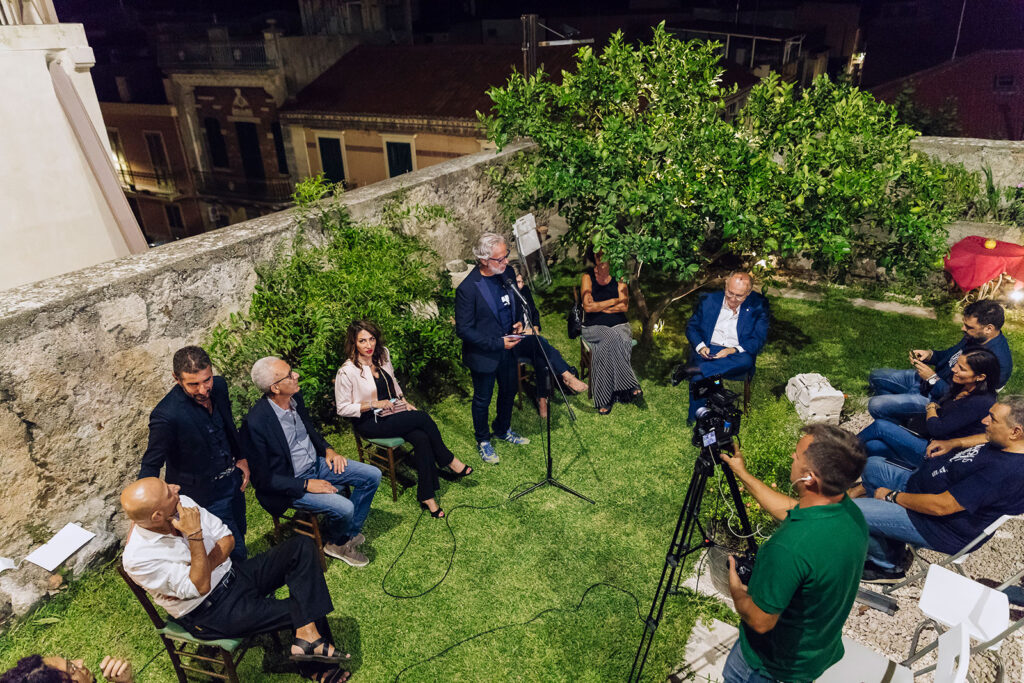



Serena Bonura works and conducts research in the field of ecology and sustainability applied to education and communication. From her perspective, it is not possible to speak of a “South rising again”, because the South is already wonderful. However, quality of life depends on functioning schools and hospitals, not only on landscapes, the sea, and sunshine. In Sicily, there are still many things that need to be improved.
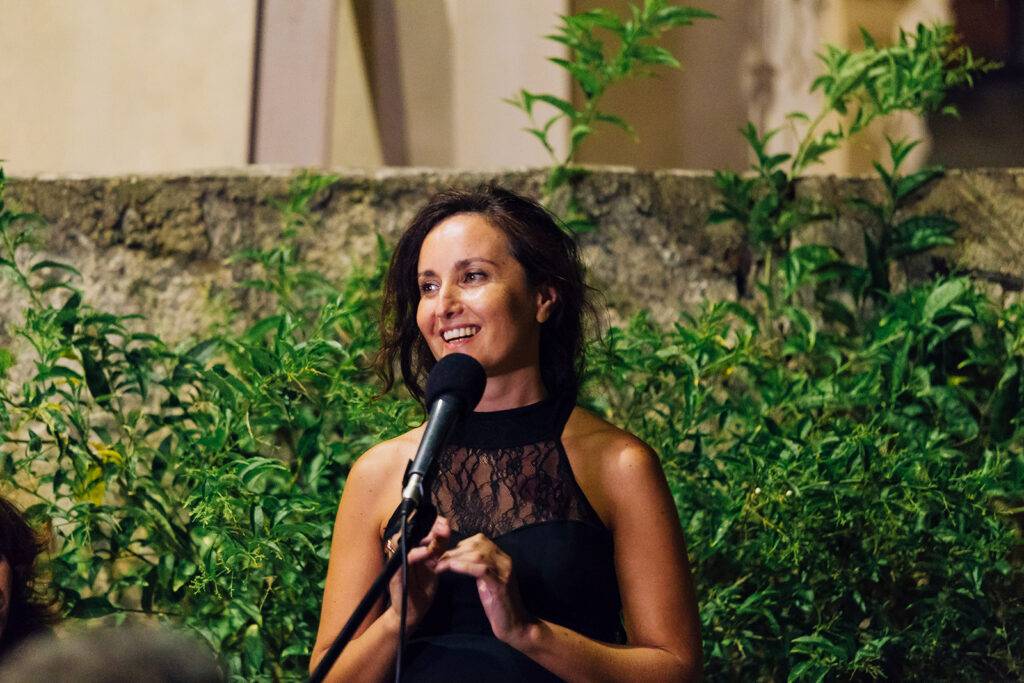
Serena lived in Bologna for a period of time, and this experience changed her way of seeing the world (and the South). For her, ecology and sustainability–particularly in relation to food–are both an economic resource and, at the same time, a way to avoid impoverishing and degrading her homeland.
The “new economy” and “circular economy” – emerging outcomes of a more conscious view of the environment–are already quickly turning into slogans. Yet, in reality, work has barely begun in this direction. It is as if anticipating the concept, without having fully experienced it, has already worn it out and made it feel outdated.
For the South, and for Sicily in particular, this is not just an abstract representation: it is one of the viable paths to building an economy in places where, fundamentally, economic structures are still weak. This means making use of the full range of local resources and activities, especially in connection with the agri-food sector.
In Sicily, a new economy can truly be activated starting from tradition. However, Serena emphasizes that speaking of tradition does not mean returning to outdated or obsolete ways of doing things–or worse, ways of thinking.
Awareness of the present, she explains, comes from a layering of positive experiences and mistakes. Nothing should be forgotten; memory is the best key to change. This is why she speaks of “retro-innovation”: taking with is valuable from the past and reinterpreting it through contemporary tools. It is not a concept limited to food and agriculture; it can be applied to every context, everywhere. However, the Sicilian model of retro-innovation is shaped by the specific geographical, cultural, and historical identity of the South in a way that is unique–neither transferable nor directly replicable elsewhere. Just as unique as the South itself.
Circular economy generates contemporary models of consumption, without diminishing or uncritically glorifying the past. It is also an “economy of relationships”, an expression that is almost a contradiction in terms, because it activates a process that evokes forms of exchange rooted in ancient memory. A sort of modern-day “pre-monetary” system.
To explain better, we work in co-production with aggregated consumers from the other areas of Italy, the Gruppi di Acquisto Solidale, who agree to share the production risks inherent in agriculture (especially climate-related variables), paying farmers in advance. In this way, the producer does not “run alone” with the risk of not making it, thanks to the pre-financing provided by consumers.
It is a model that is also spreading to other European countries. For example, some Sicilian consortia have signed agreements of this kind with French consumer groups.
Here, then, still in an embryonic form, is the answer to the provocation of “Invisible Mediterranean(s)”: restarting Italy and Europe from the South.
Another example: in Catania, a startup called Orange Fiber was founded by Adriana Santanocita and Enrica Rena. By recovering citrus waste, they created an exclusive, high-quality textile. Last year, Orange Fiber began a collaboration with the Swedish brand H&M, which chose the Sicilian company to produce part of its Conscious Exclusive 2019 premium collection.
Also from Catania comes another hight-tech startup, Kanèsis, which developed a system to produce the first eco-sustainable plastic. It is an innovative material derived from industrial plant waste, including hemp, designed by young engineering student Giovanni Milazzo and his team. It is a thermoplastic composite with properties similar to conventional petrochemical plastics, but with improved resistance and lightness. Recently, Kanèsis signed an agreement with Lati, an internationally established firm. Here again, we see Sicily projecting itself toward Europe and beyond. France, Sweden…we set no limits.
It is a very rigorous narrative, and it conveys the idea of a “great South”. But to what extent does the less luminous and less enterprising side suppress and hinder the emergence of this “great South”?
The South is beautiful.
The South is intelligent.
The South is enterprising.
But the reality we experience must contend with serious inefficiencies that not only slow down development, but also deteriorate the quality of life: hospitals and schools that do not function – or function poorly– are defining feature of our island. We often take refuge behind the excuse of lacking infrastructure, almost as a mantra, but the problems lie elsewhere.
The issue of infrastructure is one of the most painful and recurring themes in the current debate on the South, even more so in the Strait area. Your position may sound counter-current.
It is true that there is a lack of connections, including important ones– I do not intend to deny the obvious. But this is not a recent discovery; it is a problem that dates back to the post-war period, the 1960s, and even earlier. And it has never truly been resolved, except in small stretches. Much of the territory is at serious hydrogeological risk, and when building large-scale infrastructure – such as a motorway section or a viaduct– any uncertainty or design indeterminacy must be eliminated beforehand. In Sicily, there are many “ruins”: remnants of reckless infrastructural dreams, abandoned due to procurement issues, geological risks, conflicts between responsible authorities, or lack of funding.
The railway doubling project between Giampilieri and Fiumefreddo di Sicilia – currently in the news–would run through an area known to be prone to landslides, and of the planned 42 kilometers, 38 would be in tunnels.
Up to now, train stations have actually served nearby communities; after the works, they will be moved outside urban centers, making it necessary to create additional connection networks and invent new models. In Sicily, the key is proximity, not mega-infrastructure. Not least, organized crime infiltration has historically taken root in large public works. Here again, memory is essential because it reveals mistakes–preferably ones not to be repeated. To better understand the infrastructure issue in the South, we can use a parallel: we continue to talk about illness, whereas we should reverse the perspective and begin to consider health as the model.