


Invisible Mediterranean(s) is a permanent project; it does not end with the duration of the Journey. It seeks connections and pathways, nourished by the continuous relationship of interest that the South generates in Italy and across Europe.
Today’s Il Sole 24 Ore published an article about a Mastercard study on tourism trends in G20 countries.
At the opening of the article, journalist Gianni Rusconi referred to a statement by Angela Merkel who, during a video conference with the ministers-president of the German Länder, described Italy as a country that is not at risk and where it its reasonable to travel. Whether the “Merkel effect” will generate a flow of German tourists – provided coexistence with the virus allows it – remains to be seen.
The Mastercard report highlights a rapidly consolidating trend: “…the way people travel has gradually adapted to the new scenario. Spending on fuel, restaurants, or car and bicycle rentals reflects a growing inclination toward ‘on the road’ and local travel, rediscovering national landscape territories.”
“Invisible Mediterranean(s) – Journey Across the Strait” investigates places and tells unexpected stories with the aim of bringing an end to the sort of cultural oblivion surrounding the lands around the meeting point of the two seas, the Ionian and the Tyrrhenian.
It is a project born from a cultural initiative and private economic commitment, supported by several companies, bringing together research on territories, the enhancement of communities, and a courageous awareness of the difficulties resulting from decades of inadequate policies deaf to real needs.
Mastercard’s research has highlighted what Invisible Mediterranean(s) has been telling for the past three years.
The first two journeys were educational explorations in search of the invisible, within landscape and architecture, but also through the stories of the women and men of the Strait: in 2018 through Reggio Calabria, the Grecanic area with Amendolea and Gallicianò, Filanda Cogliandro, and the Costa Viola; in 2019 through Rosarno in Calabria, Scilla, Gerace, and Messina, in Sicily. A narrative built through dialogue, gathering testimonies and fostering discussion, bringing together the visions of authentically Mediterranean people – different in background, age, and role – who share, even through contradiction, the identity of their territory.
The third journey, in this difficult and painful 2020 (from September 17 to 20), marked a turning point.
Many things have changed since previous years.
During the summer, the whole of Southern Italy experienced a revival in tourism. After months of mandatory quarantine to contain the spread of the coronavirus and restrinctions on travel to foreign countries, Calabria and Sicily ranked among the five most visited regions in Italy. This was stated by CNA Turismo together with Eurispes. Visitor numbers far exceeded expectations.
The pandemic generated a flow of interest toward the South, and the South revealed the most exposed part of its territory, arousing attention and curiosity even toward its “invisible” aspects.
The protagonists of the third edition of Invisible Mediterranean(s), even more motivated to express–according to their own sensibilities and without conforming to standardized language–the “invisibility” of their places, celebrated through the journey itself and through debates both the territories–in Sicily, the system of the Ionian valleys of the Peloritani Mountains between Capo Scaletta and Capo Sant’Alesso, and in Calabria, from the Tonnara di Palmi to Gioia Tauro–as well as the strong desire for integration within the European context.
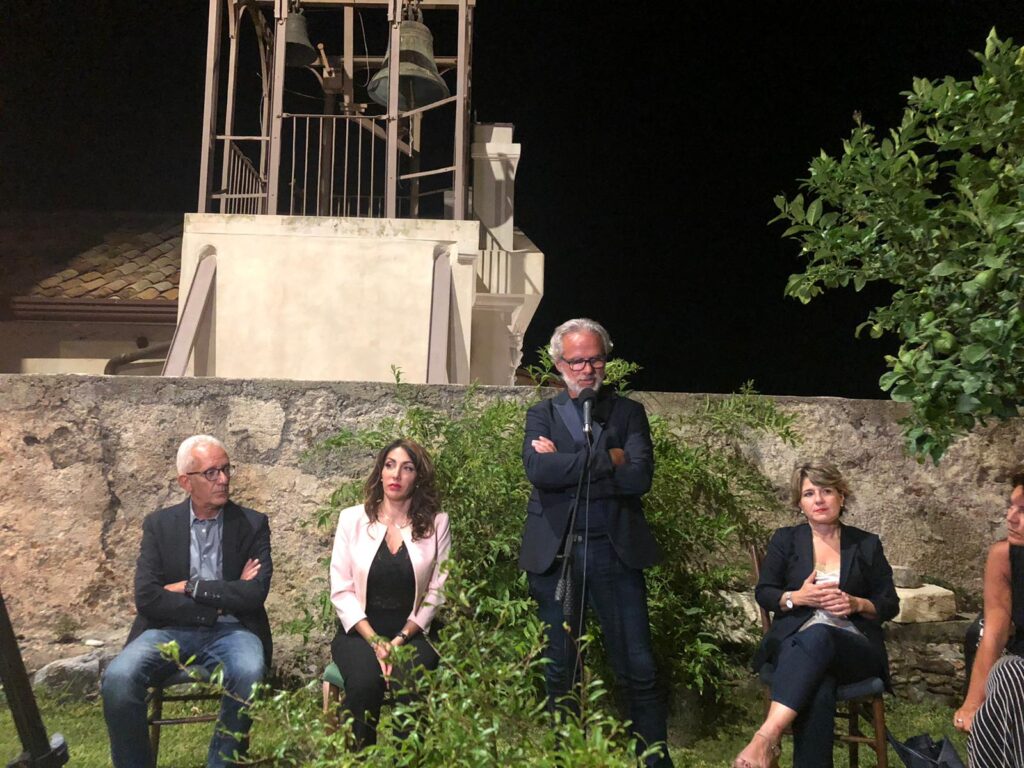
Courageous in denouncing the difficulties – from the lack of infrastructure, to the managerial inconsistencies of urban centers, to the territorial-scale dissonances of the Port of Port of Gioia Tauro, and even the unresolved and painful issue of the ‘Ndrangheta, which undermines strategic planning–many mayors took part in the Invisible Mediterranean(s) talks: Piero Briguglio, mayor of Nizza di Sicilia, Nancy Todaro, deputy mayor of Alì Terme, Natale Rao, mayor of Alì, Giovanni De Luca, mayor of Fiumedinisi, Natia Lucia Basile, councillor for culture of Roccalumera, Rosanna Garufi, councillor for culture of Furci Siculo, Sebastiano Gugliotta, mayor of Pagliara, Giuseppe Briguglio, mayor of Mandanici; Armando Neri, deputy mayor of Reggio Calabria, Giuseppe Ranuccio and Wladimiro Maisano, mayor and councillor of the municipality of Palmi, Aldo Alessio, mayor of Gioia Tauro, Giuseppe Idà, mayor of Rosarno, Andrea Tripodi, mayor of San Ferdinando.
Also in agreement in affirming that the post-pandemic “renaissance” could recalibrate the map of the map of the Strait by relaunching economic investment through culture, tourism, and agriculture, were the presidents of the territorial Orders of Architects: Salvatore Vermiglio for Reggio Calabria and Francesco Miceli for Palermo; together with the “ambassadors” of Invisible Mediterranean(s)–architects active in the territory and holding academic positions at the Universities of Reggio Calabria, Ferrara, and University of Naples Federico II. For Sicily: Gaetano Scarcella and Francesco Messina; for Calabria: Salvatore Greco, Giovanni Multari, Michelangelo Pugliese, and Giovanni Aurino.
In particular, the transit area between Calabria and Sicily, shaped by geography and infrastructural limitations, is dense with uncertainties about the directions to be taken – torn between the desire for expansion and the will to protect an extraordinary heritage. This protection is not about restricting widespread knowledge, which is in fact desirable, but about resisting the vulgarization of low-cost, superficial dissemination.
The issue of the construction of the Bridge across the Strait is interwoven with and cuts across all the other reflections. Also today, an in-depth article in Gazzetta del Sud confirms the exclusion of the bridge project from those eligible for funding under the Recovery Fund, which allocates more than 190 billion euros to Southern Italy, to which are added 123 billion euros in European and national funds through 2030.
The journalist Lucio D’Amico analyses both the criteria for the exclusion and the positive employment effects (citing a study by the Bocconi University in Milan) that the construction of the bridge could have generated in the coming years. But above all, he emphasizes how the Bridge is “the infrastructure that more than any other would bring the South and the Strait area back to the center of national and international politics. And while opinions on the Bridge remain controversial, the issue of restoring the Strait to a central geographical and political position within Southern Europe is, instead, a significant opportunity for the whole country. Precisely the theme of the relationship between the Strait and Europe was the provocation of this third edition of Invisible Mediterranean(s).
We asked mayors, architects and Presidents of Professional Orders which paths should be taken to face the future of these extraordinary places, and to relaunch the country starting from the South, interpreting the Strait of Messina in a European key.
The answer was unanimous: it is possible.
The rigorous (and unsparing) analyses, the concreteness of the statements, and the proposed programmes all describe a territory ready to take off – provided that strategies and actions emerge from below, from communities, rather than being “placebo” measures adminstered by the central government.
Showing attention and listening to the demands expressed by local communities, using European funds and allocating dedicated resources, and aligning interventions with territorial vocations: these are the actions that can drive renewal.
In multiple voices, there is a call for the need not to impose a pre-established vision –something that has happened in the past, for example in the mid-1970s, when, within the framework of the special project for the development of infrastructure in the province of Reggio Calabria (CIPE Resolution of 1974), the Port of Gioia Tauro was built. The scale and structural characteristics of the work were determined by its original functional purpose, serving the industrial settlements planned by the Government Authority, which envisaged the creation in Calabria of Italy’s Fifth Steel Centre. In the early 1980s, the construction program came to a halt due to the well-known crisis in the steel sector, which in reality had already begun in the previous decade. The port was therefore converted from an industrial port to a multipurpose one, requiring the redefinition of infrastructure programmes, operational structure, and development plans.
As stated by Giovanni Multari, architect and professor at the University of Naples Federico II: “Gioia Tauro is a geometric center, but also a generator of economic and political meanings. A place of missed strategies and lost opportunities. The Port of Gioia Tauro is a giant facing only the sea, turning its back on the land, because it generates little local impact, is self-sufficient in its function and organization, and is more inclined to look toward the Suez Canal or the Strait of Gibraltar than toward its own plain.”
However, as explained by Giuseppe Idà, mayor of Rosarno “it is also the third in Europe and the largest in Italy for transshipment, the transfer of cargo from one ship to another, usually through unloading and reloading in port; it takes place in hub ports where many shipping lines with different origins and destinations intersect. In the area surrounding the port, the flow of goods and culture intersects and integrates.”
Also, Salvatore Greco, architect and council member of the Order of the Architects of Reggio Calabria, brings the issue of the port back to the territorial scale. “The port is a ZES – a Special Economic Zone – which means that goods are produced and processed there, and trade takes place within the port itself. The lack of adequate rail infrastructure and railway terminals hinders the development of its potential economic spin-offs.”
Supporting the territory means fostering its cultural and tourist vocation.
Once again Salvatore Greco helps frame the issue: “(…) I believe that an extreme form of protection is preferable to misguided interventions or redevelopment solutions that turn villages into something resembling an Indian reservation. That would mean losing wealth, not gaining it, making room for a form of consumption that empties places out – a disposable, use-and-throw away approach to territories. We must encourage a gentle form of tourism, not one that is offensive and arrogant.
A landscape transformed into a postcard panorama becomes aligned with an undifferentiated multitude of postcard landscapes. The danger is that the richness of values may be reduced to a merely temporary purchasing power – and then be lost forever.”
Adds Michelangelo Pugliese, architect and professor at the University of Naples Federico II: “Calabria is a landscape that cannot be trivialized through opportunistic interpretations tied to places, villages, coastlines, or mountains. Beginning with the villages themselves, we are not speaking about idyllic situations, as the term might suggest regardless of context. Often these villages are not only abandoned places, but also devastated by mercilessly ugly construction. Violations that have been committed and, unfortunately, layered over time. The complexity of reinterpreting them also involves the issue of dwelling, which contemporary life has profoundly transformed.”
“Not everything can take the traditional tourism paradigm as its model for development, either because there is no spontaneous vocation for it, or because places do not wish to transform themselves in that direction, – explains Gaetano Scarcella, architect on the “Sicilian side.” “For example, the Ring of Nisi is a circular network of paths connecting the four centers of a valley marked by subtle and previously unexplored landscapes, abandoned workshops, agricultural scenery, and scattered monuments. (…) If it makes sense for the revival of a territory to pass also – though not exclusively – through tourism, then it is necessary to find the right and respectful interpretative key, because these are still unexplored places.”
Inaccessibility and the lack of physical infrastructure remain the constant factor – a brake and an obstacle to any hypothesis of development.
Salvatore Vermiglio, president of the Order of the Architects of Reggio Calabria, takes a particularly strong position regarding the Bridge across the Strait of Messina: “A coordinated and parallel project involving both the bridge and the related infrastructure would mean transforming Sicily and Calabria into Europe. Stepping back from the commitment to build the bridge, on the other hand, means remaining still, anchored to that prefabricated vision of Southern Italy, denying its European and global potential. To deny the bridge means to remain invisible. The invisibility of the territory is not a protection of its beauty, but rather damage to its enhancement and dissemination. An effective parallel, in all its harshness and discomfort, is the contrast between expansion and contraction. The risk of contraction is extremely high and, in a global context that tends toward expansion and integration, the danger of permanent exclusion from development processes increases.”
The political attention currently focused on Southern Italy thanks to the Recovery Fund cannot ignore the actual needs of the territory. As Francesco Messina, professor at the University of Ferrara, stated: “There is a total lack of attention from central government toward real needs, and even local politics struggles to understand the priorities.”
Francesco Miceli, president of the Order of Architects of Palermo, broadens the perspective: “Accessibility to the enjoyment of heritage, as well as public spaces, concerns the issue of citizens’ rights. Providing infrastructure to a territory means enabling every individual citizen to access it.
The lack of accessibility represents a denied right to historical and cultural heritage”.
The protection and enhancement of the territories along the Strait cannot be resolved through infrastructure alone: smaller towns and peripheral areas, suspended between a distinct identity and degradation, must become part of a broader project aimed at safeguarding their identity. Explains Miceli: “The connection with the most authentic territory is difficult to preserve for smaller towns: the relationship between urbanity and rurality becomes increasingly complex, to the point of tearing apart and becoming distorted – Palermo is a paradigmatic example of this. The interweaving of agricultural fragments within the outskirts of the consolidated city can become a major resource: these too are invisible places, though invisible in a different way from the hidden invisibility of villages. They are invisibile because people do not wish to look at them, yet they are strategic for rethinking the city – certainly not to transform them into new building developments, but to construct an identity of connection and enhancement. In order not to deny natural sustainability, the intelligence of the place, and to exalt its resilience.”
To the concept of a natural limit impoed by geography is added that of a self-imposed limit, as explained by Messina “Limitation is the truly serious problem of our territorie: the Strait of Messina has a geographical and political specificity, a point of tension between the Italian mainland and the island, a great water square where the distance between the two shores is ‘dialectically’ variable. Invisibility is a limit tied to the difficulty of physical connections between places, a condition that feeds and perpetuates itself through the restraint imposed by a culture of conservation which, through a cognitive distortion, becomes intertwined with certain environmental policies.
Thus, a geographical limit is transformed into a major political limit that discourages development projects and fosters the abandonment of territories surrounded by ever-higher mental walls”.
Territories along the Strait must – by right – find their place within European geography. To achieve this, suggests Giovanni Multari “Before thinking about new projects, we should first conduct a survey of what already exists – abandoned places and unfinished construction sites. We should involve a network of local enterprises, freeing ourselves from a system governed by a politics of favors that has damaged all of Italy, and Southern Italy in particular.”
The project Invisible Mediterranean(s) was initially conceived with the aim of revealing little-known places – scarcely photographed or narrated. It sought to satisfy a desire for knowledge about a unique part of Italy. Over the course of three years, the project grew and evolved, feeding itself through a deeper understanding of the situations and territories involved, and setting increasingly ambitious goals – foremost among them, transforming the Strait area into a new center of energy for the entire Old Continent.
The opening photo is by Mario Ferrara.