

IN THE PLACES OF THE SOUTH, MEMORY AND GAZE EXIST IN A RECIPROCAL RELATIONSHIP: ONE REMEMBERS, THE OTHER REVEALS. THE INVISIBLE BECOMES FEELING AND EMOTION, NOT TO BE DISCOVERED, BUT TO BE IMAGINED. PENTEDATTILO AS SEEN BY SALVATORE GRECO
The story of Pentedattilo – the name means “five fingers”, referring to the distinctive rock formation of Mount Calvario overlooking the Ionian coast of Calabria – comes to an end with the earthquake of 1783. Or rather, the earthquake marks the beginning of a long decline that would culminate in the gradual and irreversible abandonment of the village, until, by the 1960s, it had become a ghost town. Yet Pentedattilo’s history stretches back much further. Founded around 640 BC by the Chalcidians, it later became a strategic fortress controlling the Sant’Elia riverbed, a vital route leading into the Aspromonte mountains.
By the end of Roman rule, the passage through the valley was no longer essential to the region’s geopolitical balance. Over the centuries, the village changed hands several times until, in 1686, it was acquired by the Alberti family of marquises.
A bitter feud between the Alberti family and the Abenevoli – the former feudal lords of Pentedattilo – gave rise to a bloody tale of murder and massacre, fueled by what was ostensibly a romantic rivalry.
From this story emerged the village’s dark legend: one day, the immense hand-shaped rock with its five stone fingers would come crashing down upon humanity, punishing it for its thirst for blood. Then came the earthquake of 1783, followed by decline, decay, and abandonment. The end.
The end? Not quite.
Pentedattilo remains a place of extraordinary beauty and fascination – not only for the stories history has preserved, but above all for what is invisible, lost, or concealed.
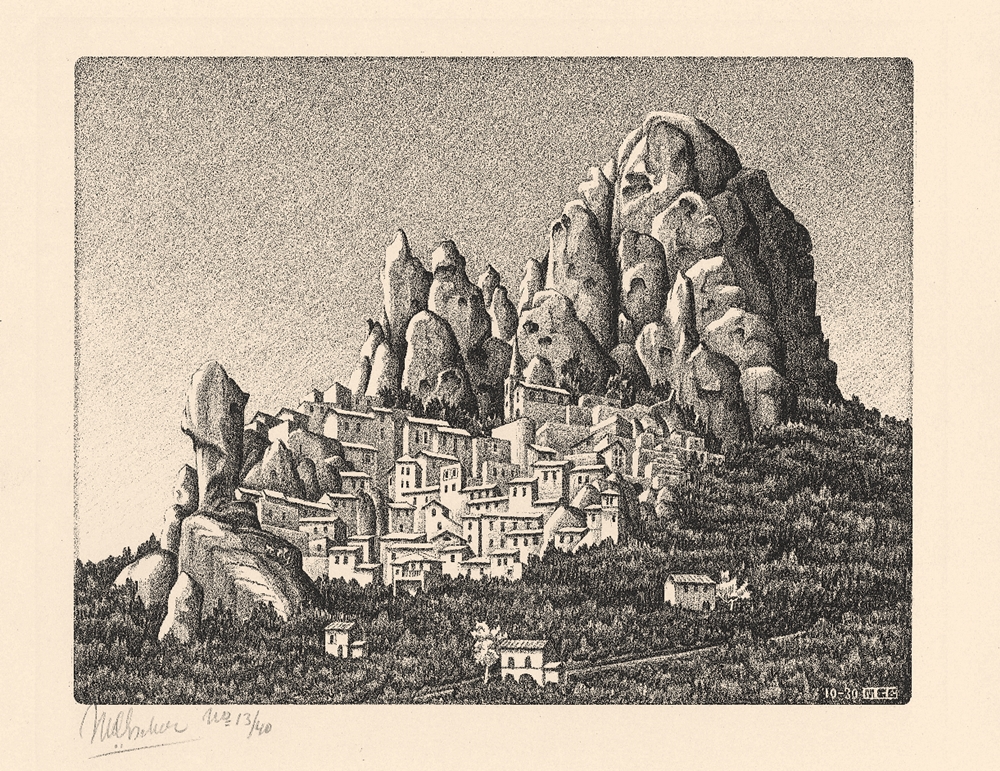
Its enduring allure was captured by Maurits Cornelis Escher, whose deep fascination with Italy and the Mediterranean led him to immortalize Pentedattilo, bringing its image to audiences around the world through his exhibitions.
Salvatore Greco renders, through a visual language, painterly impressions of places in the form of writing – at times as delicate as a watercolor, at others as stark as an engraving, and elsewhere as powerful as an oil painting. He reveals not only what lies hidden, but also what no longer exists and can return only through a vision in which memory and imagination blend with colors and scents, the harshness of the wind, and the sorrow of a lost identity.
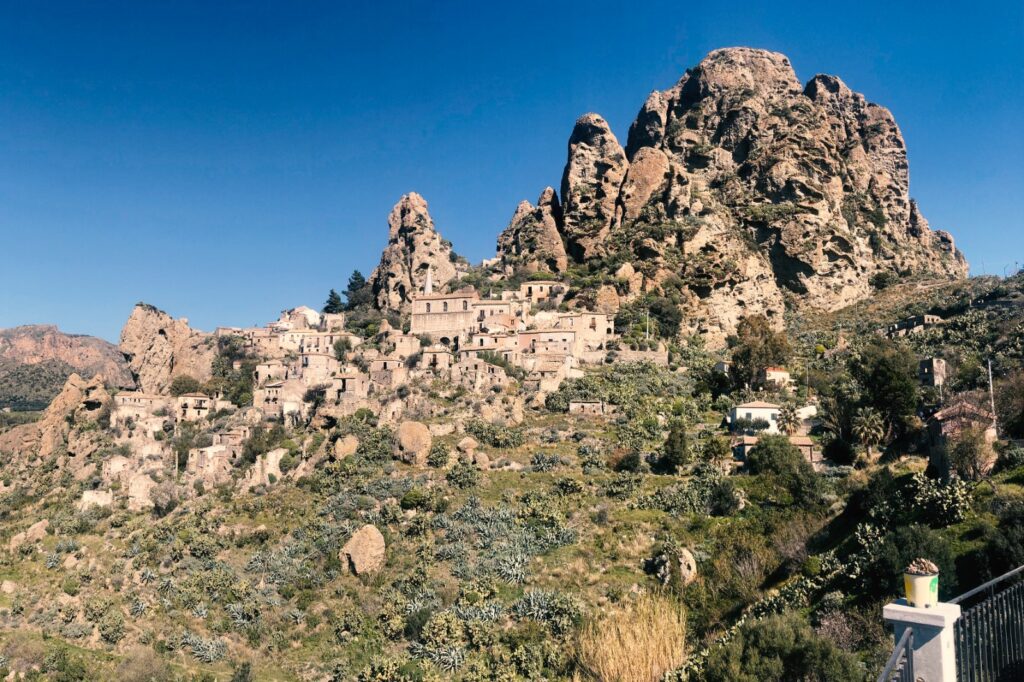
THE PERIPLUS OF THE ROCK AND THE SHEPHERDESS by Salvatore Greco
It had been only a short time – or perhaps many years. I no longer knew; perhaps it was the fault of some pandemic?
At last, I could break through that frame and step into that metaphysical image which, like a relic, had long presided over the formal sitting room of our house, proudly displayed by my father to visiting guests from afar. Only in later life did I realize that it was a reproduction of an engraving by Maurits Cornelis Escher. I was delighted by the discovery, for it confirmed that the vision before me was neither fantastical or hallucinatory.
At last, I would go beyond the icon, beyond the two-dimensional image I had known through countless readings and the worn, low-resolution pages of the web, which over the years I had consulted in an effort to reclaim my own personal fragment of Calabrian-ness – I hope not in its merely picturesque form.
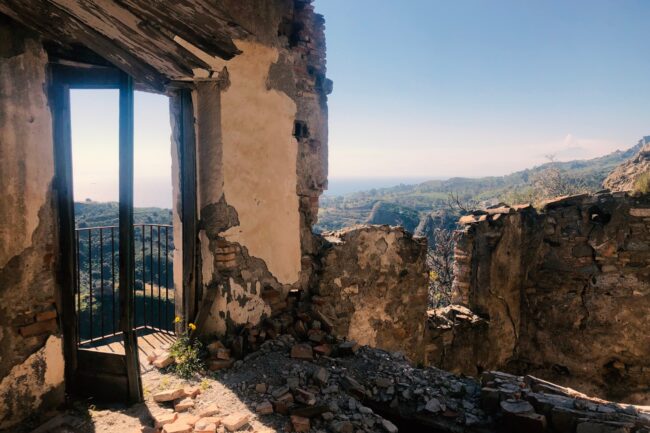
For a few moments I stood there, hesitant before the scene. Then I pulled my old SLR camera from its case and began shooting photograph after photograph, moving chaotically up and down through its deserted wrinkles and among the ruins of its clinging houses.
Pergolas, wide-open doorways, reed partitions, peeling plaster, walls once painted in bold fresco colors now faded and weary, inscriptions and drawings almost primitive in their simplicity, weathered rooftops, roadside shrines, water cisterns, and tiny hanging gardens. Yet I was not an Asian tourist rushing through Italy on a whirlwind visit; time was not something I lacked.
I was welcomed by the broad, rounded limewashed wall of the little square beside the church, commanding a sweeping view. I lit my first cigarette, put my camera away, and sat down to reflect. Two red chairs and a small table stood there, in the middle of a charming public space with no urban furnishings at all.
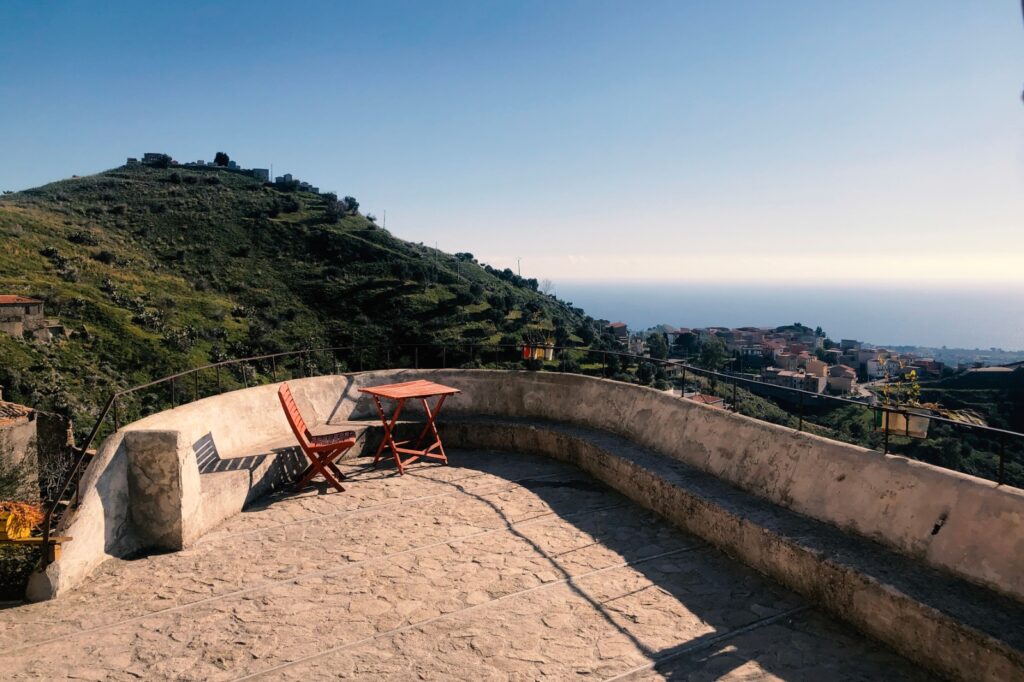
A settlement with no cardo or decumanus, its layout shaped simply by the descending contours of the site’s topography.
I entered the church, which had stood abandoned for many years.
The inscription engraved on a commemorative stone, surmounted by the heraldic coat of arms of the Alberti family, lords of the fortress, records that, after the era of the Greek Rite, the first priest to celebrate the liturgy in Latin in this church was Don Domenico Toscano of Bova, in 1655.
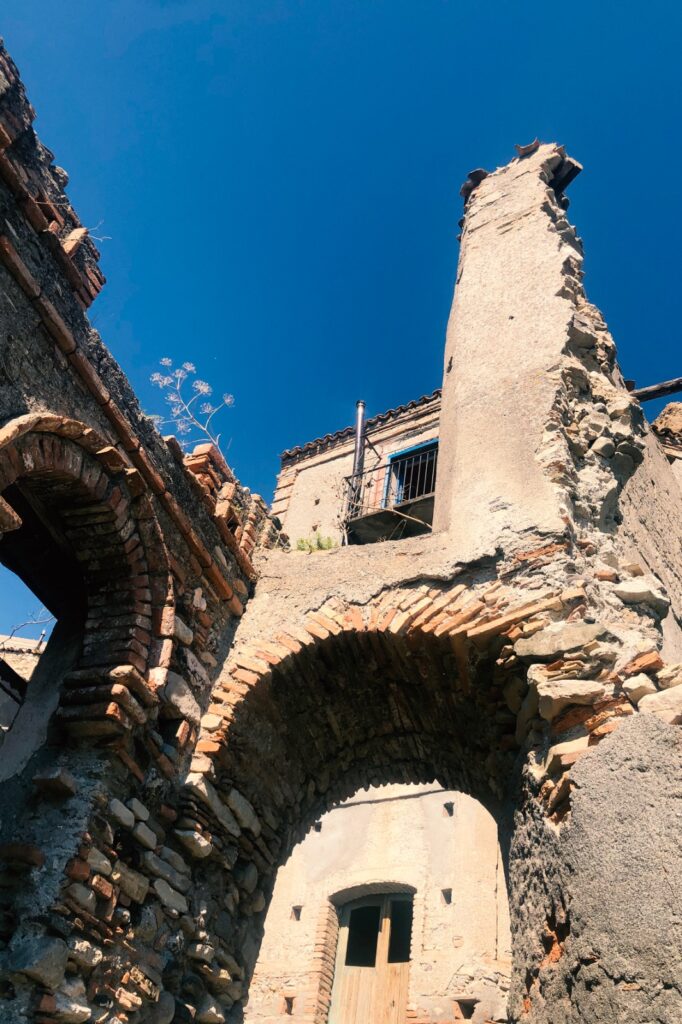
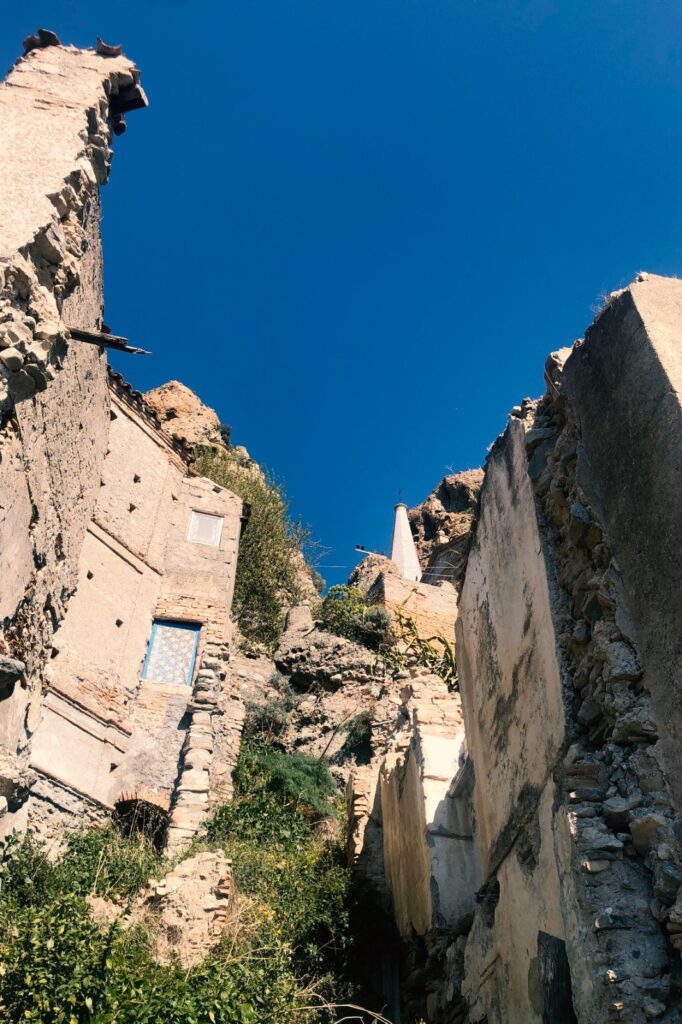
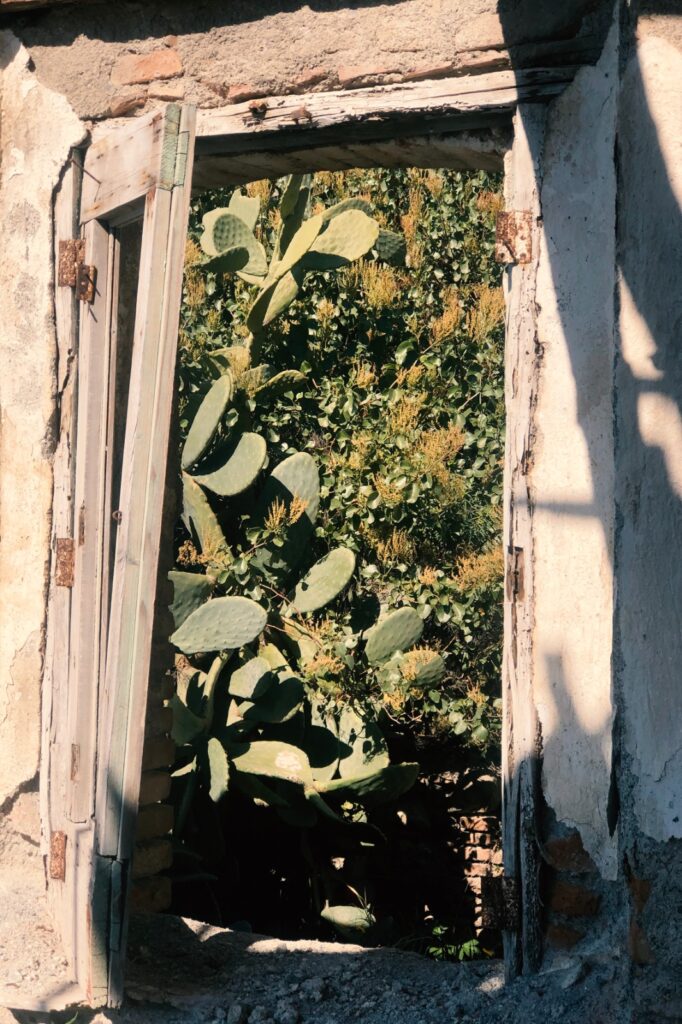
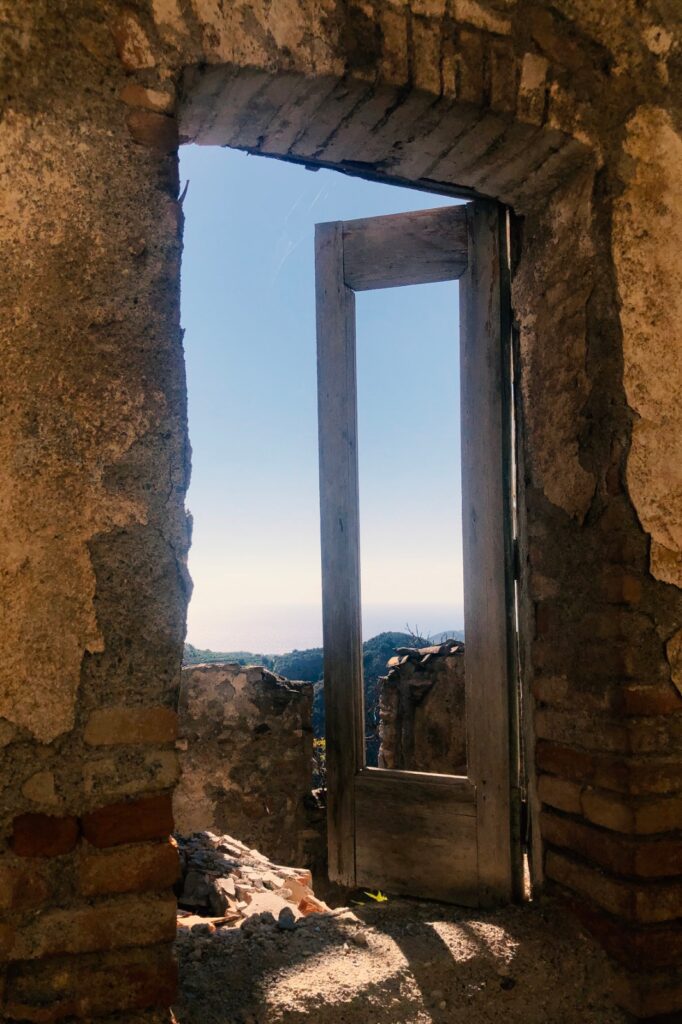
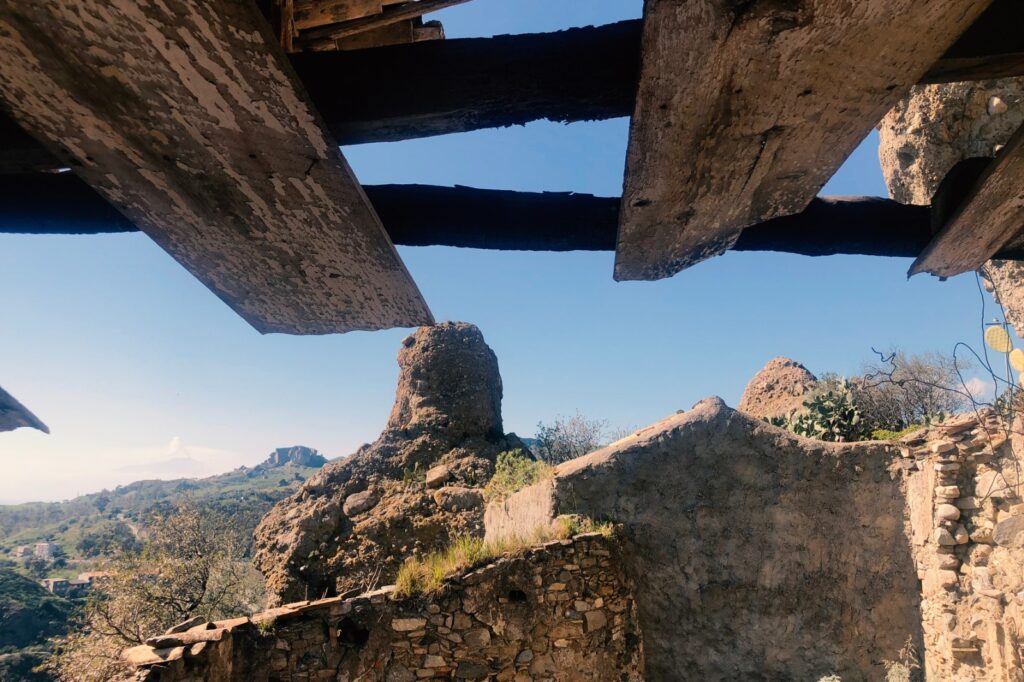
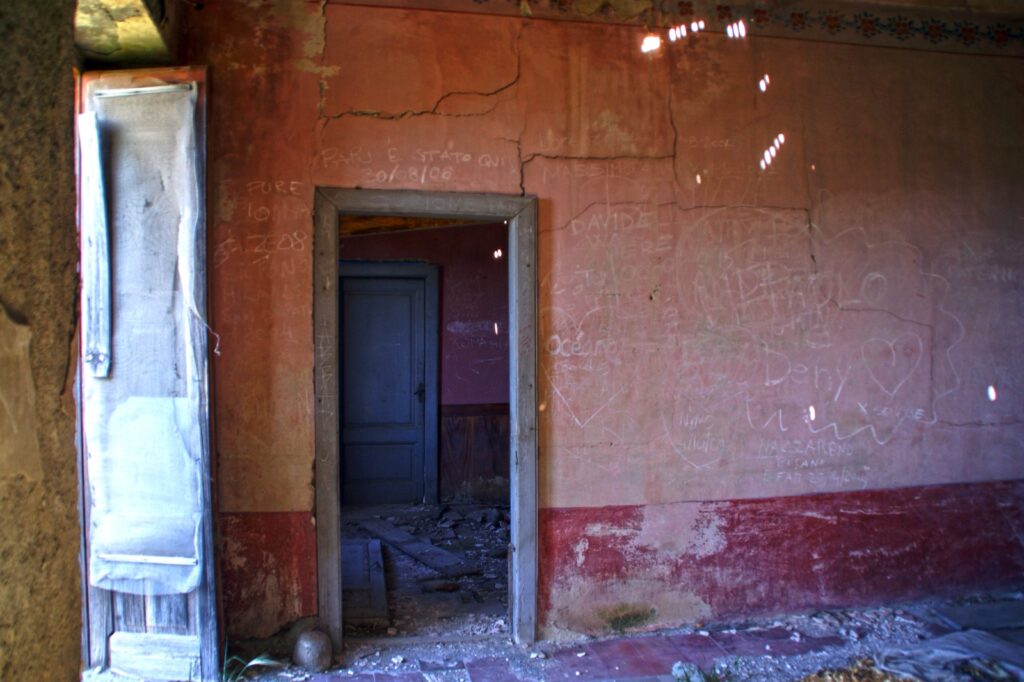
From the Greek protopapal church to the Latin archpriestly church: a historical transition to be commemorated? Or a sign of the inexorable loss of awareness of one’s own identity!
That natural stronghold seemed to come tumbling down upon me, and the holes carved by time into the reddish sandstone wall appeared like deep eyes staring at me, constantly changing expression.
What humility there was in that tangle of narrow lanes – the houses, each one different from the next, and yet all together in harmony with the landscape. Torn and weathered dwellings that had once contained simple things; inhabitants devoted to the hearth, the vegetable garden, the pig, and the church. A minimalism born of necessity, not a comforting disguise for an unconscious euthanasia – a representation masked as a contemporary trend, where many stylized houses, lacking even the smell of a simple sauté, are inhabited only by diligent domestic helpers.
The old inhabitants had turned themselves into master builders, architects and perhaps something even more!
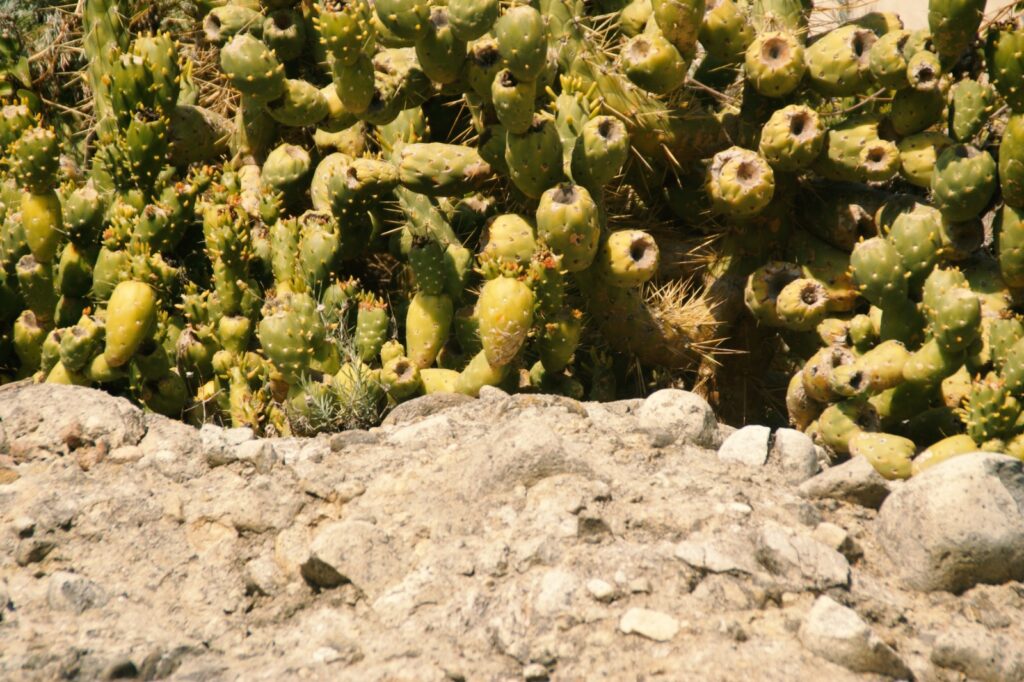
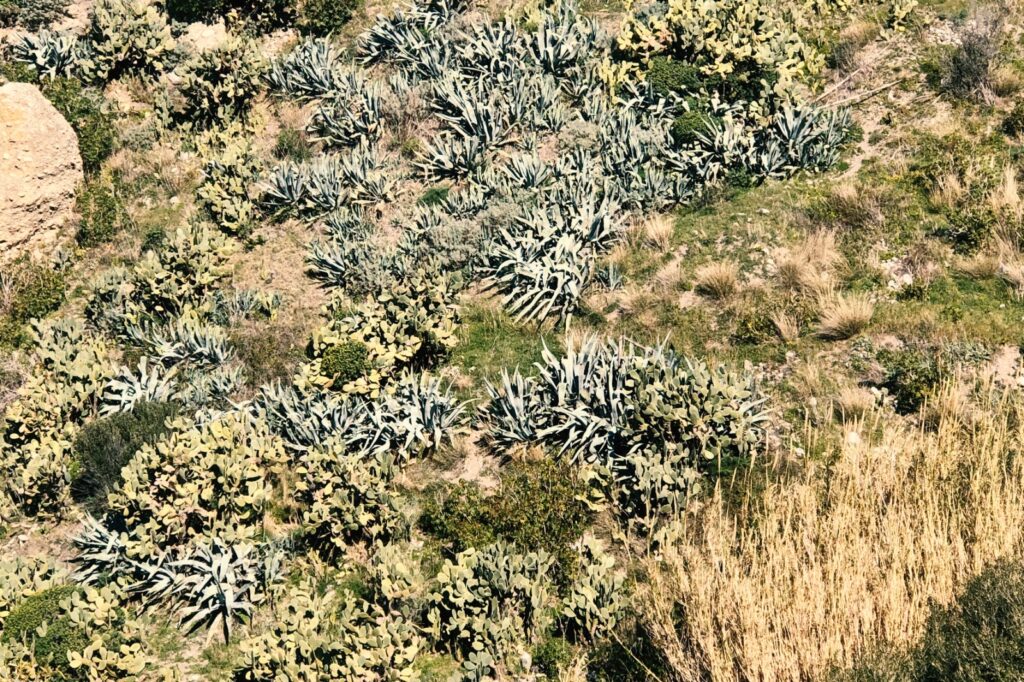
It was already ten o’clock in the morning, and the sun was beginning to make its beneficial presence felt. I had an appointment to keep! So, in order to move more quickly, I decided to take another path, a shorter one, and thus discover the B side of that island of stone, amidst the early unfolding of spring. I set off along a lonely trail, my gaze constantly shifting between the seaward horizon, stretching as far as Sicily – the Messina coastline and beyond – to the volcano of Schizzo, and the to Mount Etnam ever closer, its snow-covered summit contrasting with that foreground of scorched earth, dotted with prickly pears, agaves, and wild fennel. Above it all, the rock face grew increasingly imposing.
At a certain point, I left the path and made my way through, searching for unusual encounters. Among ears of grain turning golden and the prickly, brightly colored thistles, they did not keep me waiting!
An old Calabrian folk song sang:
Iu fici vutu di fari ‘ncastellu,
cridendu ch’era iu lu castellanu.
Doppu chi lu fici artu e puru bellu,
la pinna mi pigghiaru di la manu.
Restai comu lu pitturi senza pennellu
comu lu notaru senza pinna a manu.
A small abandoned dwelling, with a flat, walkable roof and an almond tree casting its shadow across the sunlit wall, profoundly different from all those I had encountered before, with their traditional terracotta-tiled roofs. A modern volume, a “white box” weathered by time, immersed in a tall carpet of spontaneous colors, reflected in the silent and primitive charm of this place. The majestic presence of the rock face in the background created a world apart from everything else. Simply akin to many traditional Mediterranean architectures, freed from the constraints of a floor plan dictated by the roof.
This comforted me and once again confirmed the power of the near and the distant, of the great and the small landscape, capable of resolving any stylistic dispute. I resumed walking in a state of rapture, losing myself without fear, with intangible thoughts beneath the shadow of the rock. In the distance, I caught sight of a small wayside shrine; the path I had left behind had to be somewhere nearby.
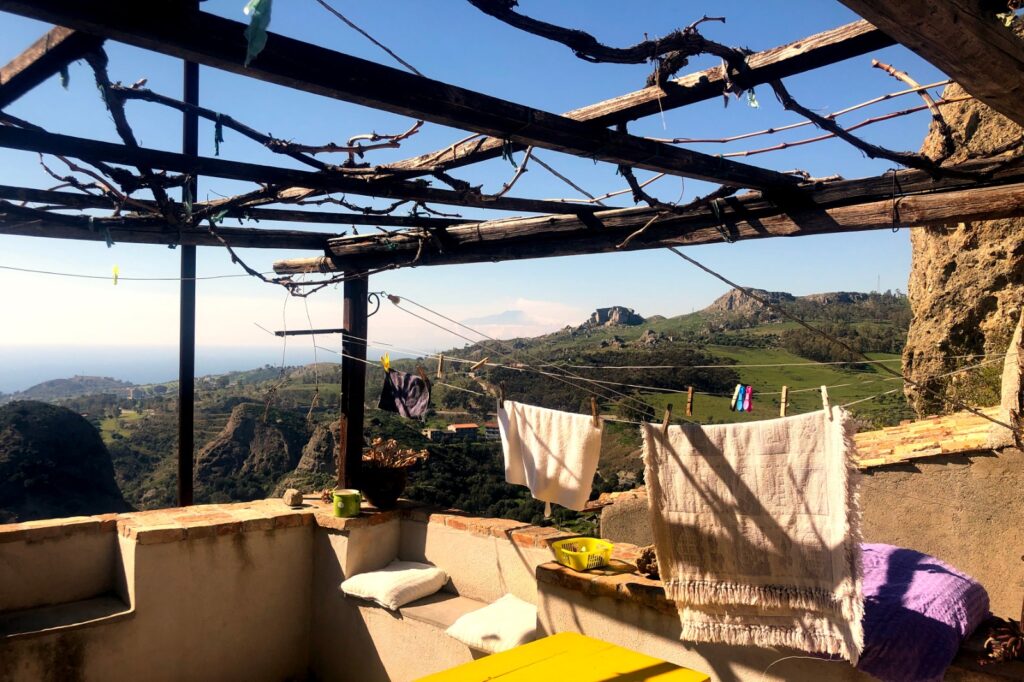
Almost without realizing it, as if by magic, I found myself at our meeting place.
Rossella, the shepherdess – the last inhabitant, the Etruscan guardian of the land of the Greeks of Calabria – was there waiting for me, busy with her daily chores. She spoke only a few words, simple yet profound, and in just ten minutes she told me the story of her life!
As a young woman, she had left her hometown of Viterbo to settle in this corner of paradise in Calabria. Sacrifice and hardship were written across her ever-smiling face, along with a wisdom drawn from this ancient land. As she spoke about her goats and her plans, she seemed to carry with her the rich aroma of freshly baked bread. Later, we found ourselves seated around the table. The simple dishes revealed ancient rituals, carrying us back through time to our Greek roots. Eating ultil we were full seemed almost like a way of dispelling the memory of the many years marked by want and hardship – years endured, despite everything, with unwavering spirit and quiet dignity.
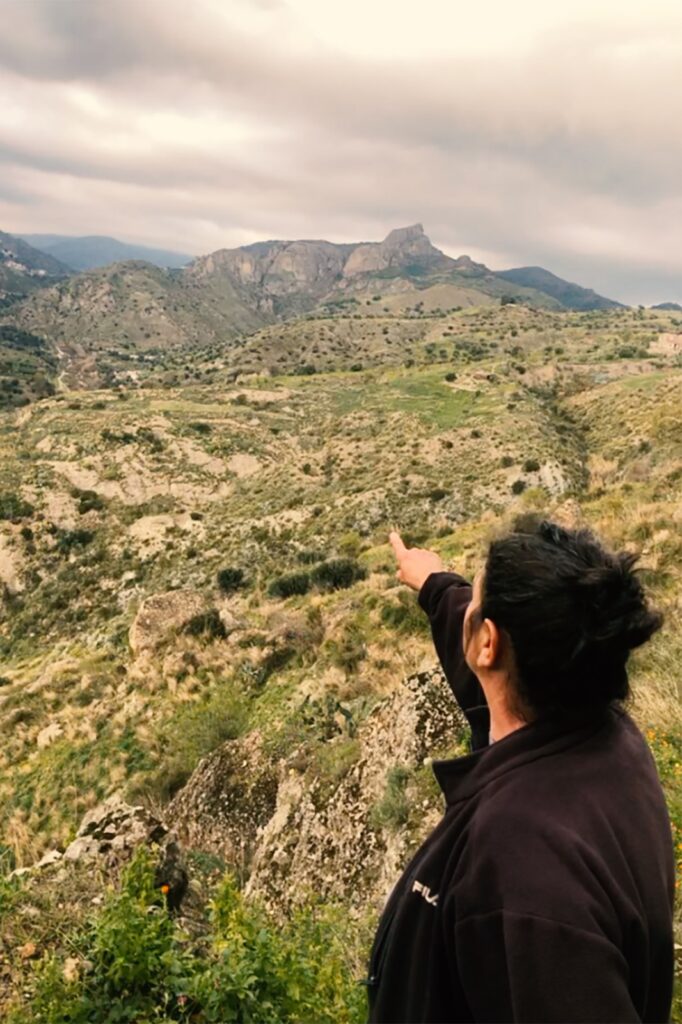
A rusted tourist sign recounted the well-known and bloody tale of what had happened on Easter night in 1686: the Alberti and the Abenavoli, a local version of the Montagues and the Capulets. Around those years came the first abandonment of the village, as the farmers gradually moved down toward the coast.
As I climbed toward the fortress, it felt as though I was creating that landscape myself – though who knows how many had done the same before me. Marcovaldo, his wife Domitilla, and their four children – Michelino, Teresa, Pietruccio, and Filippetto – had gone before me, seeking nothing more than clean, wholesome air.
Over fresh primosale cheese and talk of workaway, we chatted for what felt like an endless stretch of time. Before we parted, with the promise of meeting again, she gave me remarkably precise directions – not to a destination, but to the landscape itself. I had completed the circuit of the monolith. Still wandering through that maze of narrow alleyways, I sat down to rest, just long enough to enjoy a well-earned cigarette. Then an irresistible urge drew me upward, toward the summit of the rock – a climb of about two hundred metres to its seemingly inaccessible peak – passing so close to the majolica-clad bell tower of the Church of Saints Peter and Paul that it felt as though I were walking through it. The last remaining ruin of the fortress still bore, set into its gateway, an apotropaic mask, poised to ward off evil spirits and malevolent souls.
Reaching the summit of the rock was a foundational act, meaningful both physically and symbolically – almost transcendent. As I climbed, I found myself thinking of that magnificent testimony immortalized by Petrarch in his famous “Letter of Mount Ventoux”, one of the few lessons that had become indelibly etched in both my heart and my mind. Our own national pride has its conquest of Ventoux, too – that of the Pirate, Marco, the great champion, cherished and then abandoned.
At last, the summit. Amid the ruins of the final castle, everything seemed to have been foretold. From that lofty vantage point, my gaze wandered all the way to the coast, allowing me to read the different movements of that radiant composition.
A dwelling place of the wind, overlooked even byPaolo Rumiz in his travels. Was I standing before yet another monochrome Guernica? But there had been no civil war here. Catastrophic floods, earthquakes, and human neglect had woven yet another tapestry. All these parallels compelled me to look beyond what already been said, beyond what was merely visible, with my eyes open.
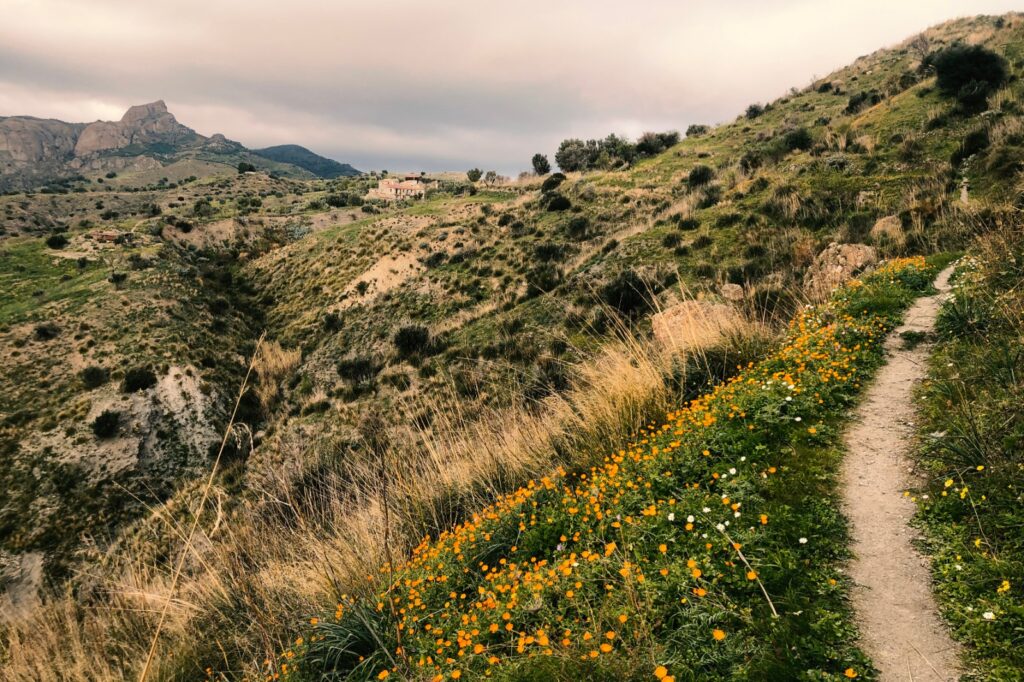
I climbed even higher and, with some effort, reached a narrow ridge. The exertion was more than rewarded by the view: I stood as the undisputed master above the ruined rooftops of the village, with the cemetery on the nearby hill and the replica of the town just a stone’s throw away.
Was this a compensatory, consoling landscape, or a critical reflection on my urban life?
Yet, in that very same scene, observed sup close, I had also come face to face with its other side: environmental fragility, the age-old culture of emergency, the very “sfasciume pendulo” (“hanging landslide”) so incisively described by Giustino Fortunato.
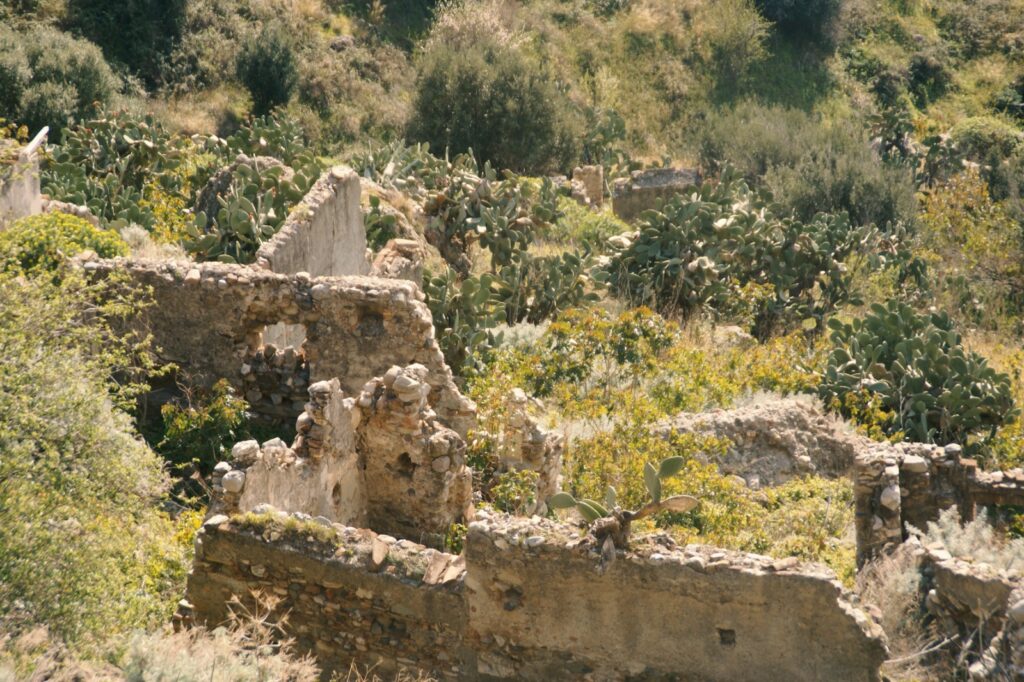
Unchecked modern human intervention had, fortunately only in limited areas, caused more damage than all the catastrophic natural events mentioned above. This restless land, lying at the convergence of no fewer than three tectonic plates, has historically condemned those who inhabited it. To complete the picture came social and urban decay, dark forces, desecration, stark contradictions, a memory stripped of depth, a Desert of the Tartars.
Italy is certainly not lacking in stone ruins and monuments, yet here the setting is not merely a backdrop or a preserved stage. The sky, the scent carried by the wind, and the vibrant colours of the endemic vegetation burst forth in an explosion of light, colour, and fragrance.
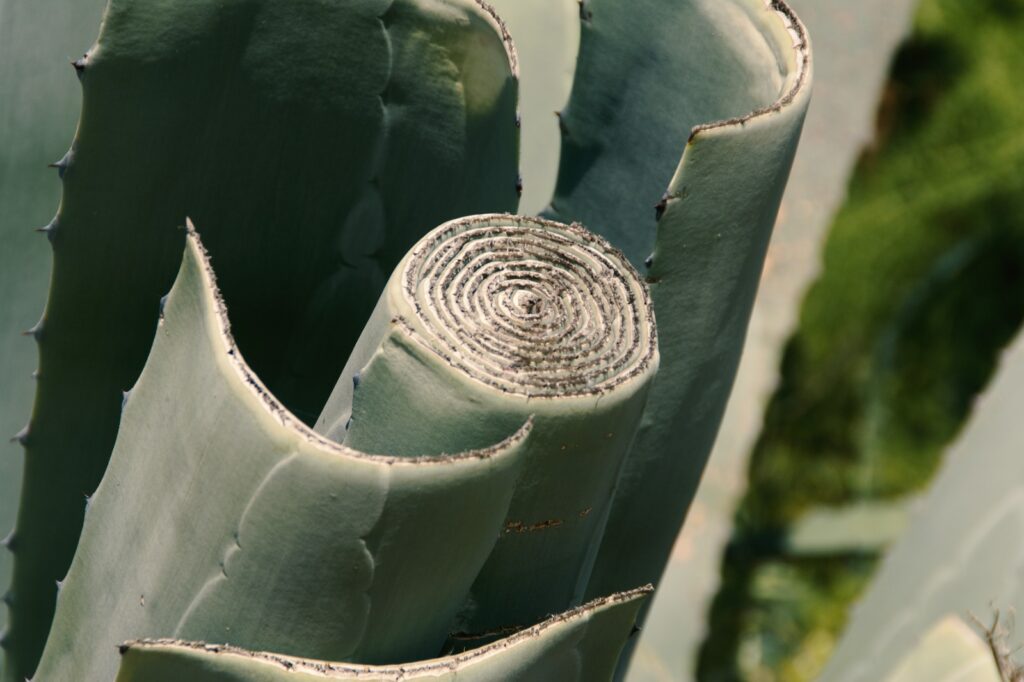
The various species of succulents seemed to heal the soul, as did the unique specimens of Centaurea and Allium pentadactyli.
The Valley of the Orchids, which I had previously crossed almost absentmindedly, revealed itself as a wordless vignette.
The Annà and Sant’Elia fiumare embraced th3e rocky outcrop in an erosive embrace, tracing sweeping lines of perspective that rose from the coastline and faded into the foothills of the Aspromonte.
At last, I had the opportunity to experience silence – an overwhelming, defining silence – and a solitude, without having to validate a single ticket.
They say that solitude is the exclusive privilege of kings. Hundreds, perhaps thousands, of sovereigns inhabited that landscape. I had not been alone; unseen green eyes had accompanied me.
To compare tha vertical, resonant silence with the other – the insidious, invisible silence of holidays in the city – filled me with anxiety. It had become at once an imperative, a poem, and a tragedy. I could no longer take photographs.
Faced with that overwhelming impression, the old university debates of the Ibrido group began pounding in my mind, together with the teachings of Franco – the white-haired master from Rome, a mento at once quiet and thunderous in the way he described the Calabrian character.
“A lucid intelligence coexisting with a courageous yet anarchic spirit, deeply individualistic, veiled in pessimism and melancholy…The Calabrian landscape always possesses a profound breadth of vision, even when it fails”.
Now, my companions on the Invisible Mediterraneans journey felt closer than I could ever have imagined. I even had the impression of seeing Ernesto running along the path just below me, Mario, Stefano, and Massimiliano scouting ahead with their tripods slung over their shoulders, while the others – and the Captain – sat in the shade of a vine-covered pergola, absorbed in conversation as they looked out over the landscape.
Meanwhile, the sun was beginning to set behind me – an unfamiliar experience – and as darkness gradually took hold, my imagination prevented me from wishing that this land might one day become the backdrop for a vas scenic and tourist industry, where its true values and meanings could be altered and trivialized.
The market economy: attracting investors, the newly wealthy – perhaps from abroad – as the overriding priority. But were we not the first investors ourselves? And what had become of our shared projects?
Gone were the days when Totò and Peppino could sell the Trevi Fountain to the unsuspecting Mr.Caciocavallo.
How many brightly colored renderings, all born of the same mediocre “copy and paste,” promoting the real-estate sell-off of mouldering cardboard metropolises. In the dendrochronology of the city, within its outermost rings still waiting to be mended, many had already discerned the grey omen of an unfinished modernity, foretold in the urban still life and metaphysical landscapes of the Futurist Sironi Mario.
The night of 16 April 1686 was undoubtedly significant for this scene, yet the approaching night carried its own importance as well, together with all the fragments of a longed-for anthropological rebirth, both physical and spiritual.
Festivals and cultural associations – the lifeblood of a suffering body. It is true that, in this land, everything is said to move slowly, “as at the extremities of an organism,” as Saverio Strati wrote. Yet, at times, this very slowness can become a virtue. What is needed is to give voice and vitality to the individual through a coherent contextual logic, within a collective resonance stretching from the archaic to the postmodern – an authentic “butterfly effect” – freeing ourselves from outdated systems that had bred harmful “landscape parasites”.
From up there, it was not difficult for me to imagine the village as it had once been, its memories grafted onto the tales of the Etruscan shepherdess. The clatter of horses’ hooves, pot-bellied dignitaries, barefoot souls, rumbling carts, echoes of distant voices, the sound of ceramelle (traditional reed pipes, the tinkling of cattle bells, walls whitewashed with ricotta, men and animals sharing the same byre, the cries of itinerant vendors, the parish priest in his triple role, the schoolmaster and the doctor, days without polish or pretence, the scent of baking bread, hermitages, propitiatory bonfires, processions of saints, foundation rites, a silenced culture, river torrents both healing and destructive – all of it flowed before me as swiftly as the closing credits of a film just watched.
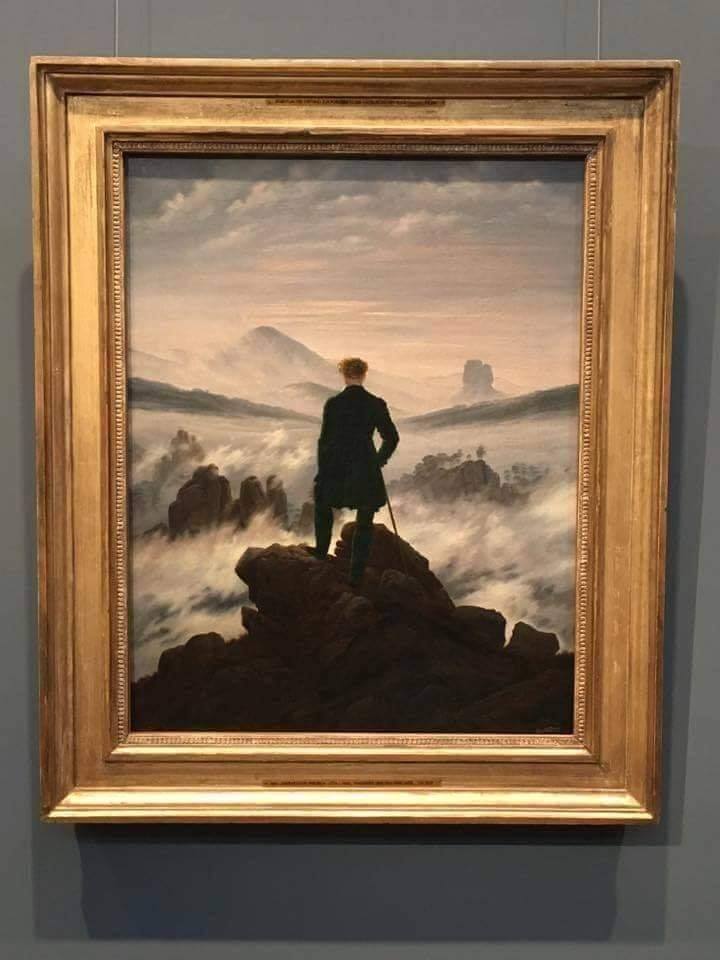
Several hours had passed, and I remained motionless, awaiting the slow sunset over the rugged mountains, my back turned and silhouetted against the light, gazing towards the coast. Suddenly, I thought I was the “Wanderer,” the emblem of the most romantic vision in painting.
Was I delirious?
The limits of human mist were now set against the grandeur of nature. Without a moment to catch my breath, subjective feelings collided with objective sensations. I searched for explanations – or was it simply the intoxication of solitude?
Forgive me, excuse the many quotations scattered along this arduous journey. Believe me, I display them not out of vanity, but as crutches, as steadfast anchors, supporting a long and difficult self-taught moral journey. They were teaching me how to signal before overtaking – and above all, how to say no to myself first.
Before returning, I realized that I had not been alone. A small lizard had spent much of that time motionless beside me, keeping me company in a kind of contemplative ecstasy. I said goodbye to it and made an appointment for our next encounter.
Photographic reportage by Salvatore Greco.
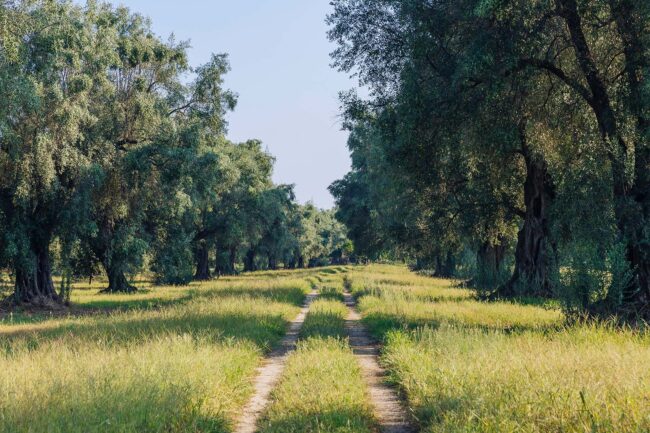
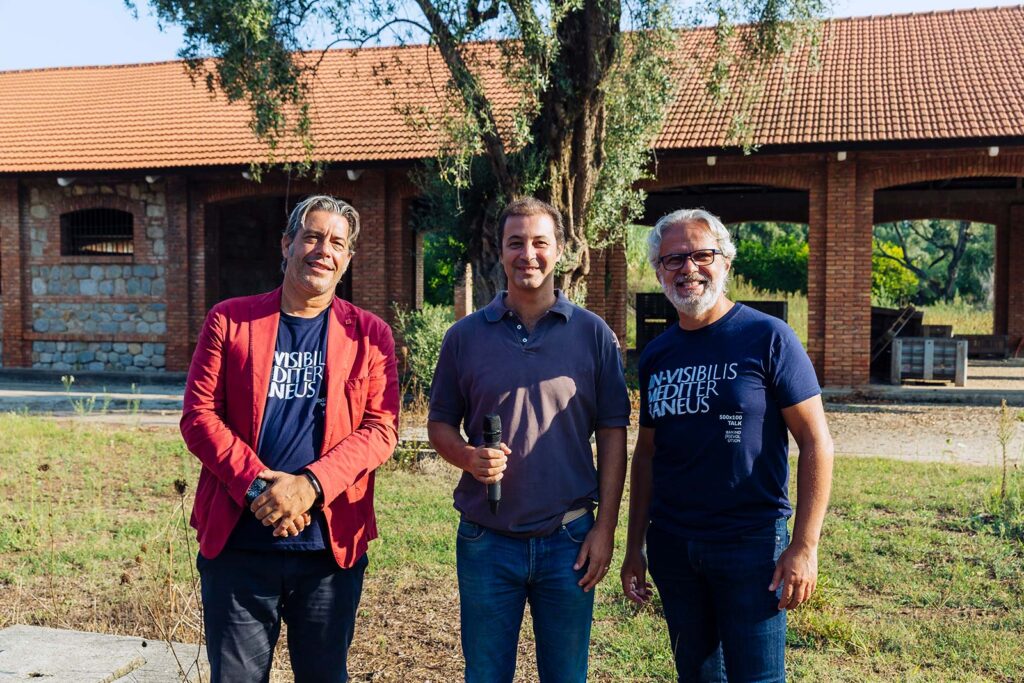 From left to right: Giorgio Tartaro, Pietro Taccone, and Alfonso Femia during Invisible Mediterranean(s) – Journey across the Strait III, talk session on 20 September 2020. Photo by Stefano Anzini.