


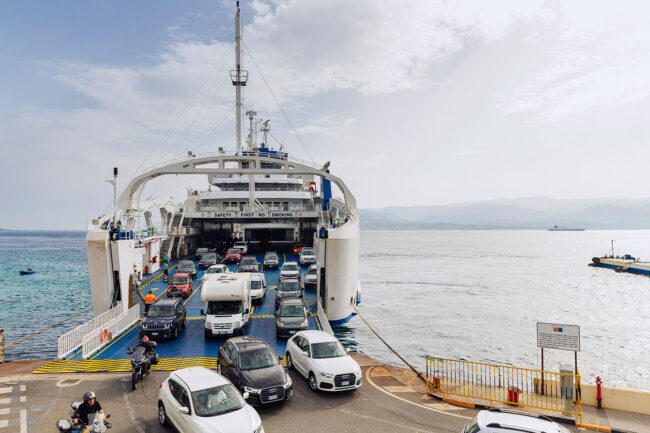
MESSINA LIES AT THE CENTER OF THE STRAIT AREA, WITHIN A POLITICAL AND REGIONAL SEPARATION THAT CONTRADICTS THE NATURAL GEOGRAPHICAL AND CULTURAL UNITY OF THE TERRITORY. SALVATORE MONDELLO DESCRIBES HOW THE CITY FUNCTIONS, WITH A GLAZE TOWARD EUROPE
Living and mobility. The port system and the water system. Identity. According to Salvatore Mondello – Councillor for Infrastructure and Public Works (with numerous delegated responsibilities) – the emergencies, urgent issues, potential, and development of Messina and the entire Strait area depend on resolving these five conditions.
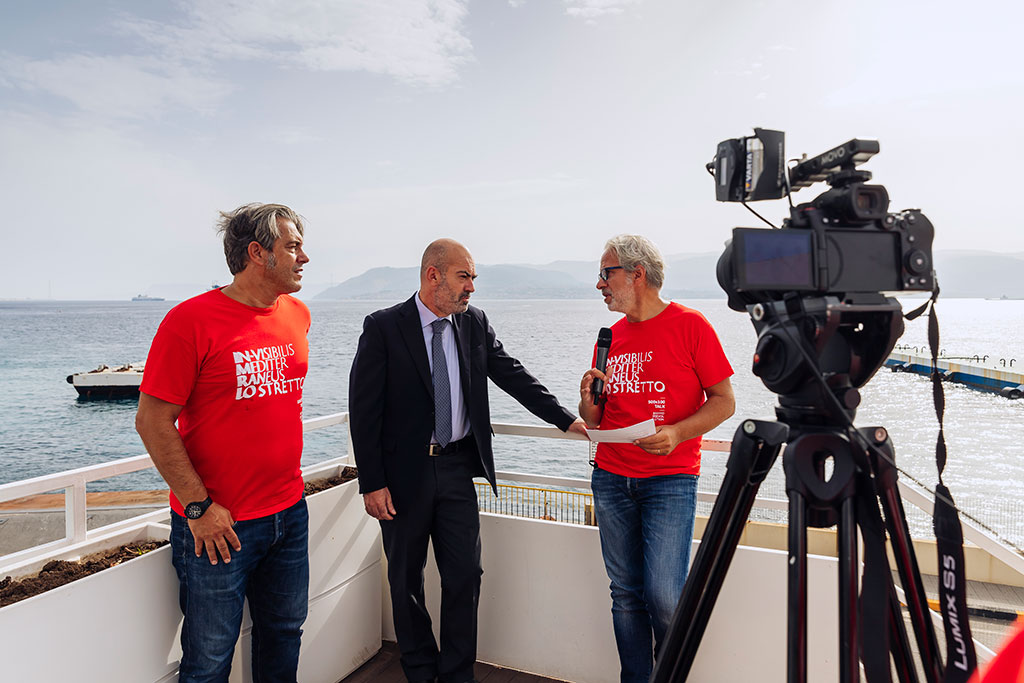
Going beyond what is visible, understanding the vulnerability and complexity of a territory that was once a destination for the greatest travelers in European and world literature, and that today struggles to reclaim its place on a national and European scale: at its forth edition, Invisible Mediterranean(s) – Journey across the Strait shares this reflection with Salvatore Mondello.
The Strait of Messina is a magnet – it has always been one throughout history – a hinge of extraordinary natural beauty”, Mondello begins. “All the great travelers of the past were fascinated by the Strait. We simply need to turn the lights back on.”
What are the real strategies for “turning the lights back on” for the city?
Mondello explains that the city stretches for 32 kilometers: on one side toward the narrow strip of land along the Strait, and on the other toward the hilly landscape behind it. It lies at the center of a broader area, even though on the Calabrian Ionian side the conurbation with Reggio Calabria and Villa San Giovanni has never truly become a reality, despite the geographical configuration.
For Gesualdo Bufalino, “… Sicily has had the fate of finding itself, over the centuries, acting as a hinge between Western high culture and the temptations of the desert and the sun, between reason and magic, between the climates of sentiment and the scorching heat of passion” (from the book “Cento Sicilie”).
Mondello extends this idea from the insular scale to the urban one: Messina is a hinge of the Mediterranean both for its port system and for its geographic position. It is a territorial context (similar to that of Genoa) that encompasses and connects very different identities.
And identity itself becomes a key issue in the cultural representation of the Strait, and at this moment also a matter of political urgency that reveals the city’s fragilities and contradictions. The Sicilian Region has in fact accepted the request of thirteen hamlets in the Messina area to hold an independence referendum. The aspiration is to create a new municipality, to be called Montemare, autonomous from the city of Messina. This refers to the northern portion of the territory, where the hillside villages are located.
Mondello explains that separating the administrations would make governance more complex. While fully respecting local identities – which in the past have already produced similar situations in other parts of Sicily – it is the territorial, historical, architectural, and landscape culture that expresses connections and differences, in other words identity itself, rather than the creation of separate administrations.
Heterogenity is the unnderlying framework that defines the entire city of Messina, as Nadia Terranova notes, “The uniqueness of Messina lies in its differences”.
According to Mondello, it is essential – precisely in order to “turn the lights back on” – to leverage the natural connections that already exist: Reggio Calabria and Messina are, before being Calabrian and Sicilian, cities of the Strait. The conurbation finds its meaning in the social, cultural, and economic relationships between the two territorial realities, even though common strategies have not yet been developed.
Mobility is at the center of development, and a shared strategy with Reggio Calabria is envisaged for a unified and coordinated management of the Strait, independently of the Bridge across the Strait, which is seen as a topic that is almost more European than local.
For this reason, within the PUMS, (Sustainable Urban Mobility Plan), in its most recent version drafted this past August, reference is made to a “Sea Metro” between the two shores of the Strait of Messina – Reggio Calabria and Villa San Giovanni on one side, and Messina on the other, through fast maritime transport services that allow movement between the cities. The work is oriented toward building a structural framework at both urban and extra-urban levels. The city of Messina and the Metropolitan City share a single mayor, and this contributes to the development of planning on a broader scale.
Turning off – after more than 100 years – the spotlight on the issue of the shanty towns is an unavoidable step in order to switch it back on over the city’s positive urban aspects: moving from decay to quality of living.
The 1908 earthquake in Messina devastated 90% of the city. Temporary shacks were then built, which over time became permanent makeshift housing. Today, demolitions have begun, and urban redevelopment works are underway, along with the definition of a new urban planning standard.
Water is the other major theme that will lead Messina toward the goal of becoming a European city.
Rebuilding the relationship between Messina and its port is essential. The work carried out in cooperation with the Port System Authority, which manages Messina, Reggio Calabria, Milazzo, and Villa San Giovanni, will mark an important phase of urban development for the city.
The Tremestieri port, currently being upgraded, will be able to accommodate up to seven ferries. It will expand southwards with a 320-meter breakwater jetty exposed to winds, and a 34,000-square-meter storage area.
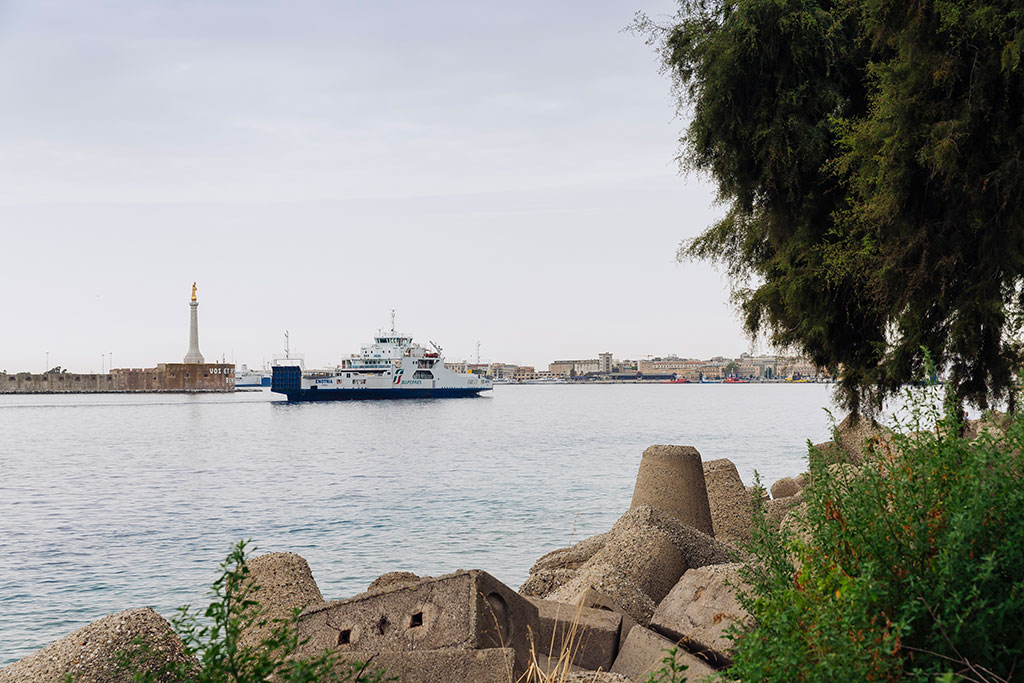
The new port will allow ferry traffic to be removed from the Rada of San Francesco, which can then be transformed into a tourist marina. In this way, the navigability of the Strait will be ensured, and the connection between the sea and the city center will be restored through the functional redevelopment of the Rada.
Access to public water, purification, and wastewater disposal – in other words, the efficiency of the water system – is another major issue in the redemption of the Strait area.
Sicily loses 50,5% of its water through distribution networks. Water scarcity has, in the past, created even very serious problems. A process of rationalization of the overall system is now underway, including the introduction of remote monitoring systems for the water network.
The Fiumefreddo aqueduct is the main water resource available to the Messina system. Sicilian fiumare, like those in Calabria, are highly intermittent by nature due to geomorphological conditions: they appear suddenly and briefly, then disappear. Water resources, which can be collected and stored in reservoirs, are also present in the hills. The municipal administration and Amam (Azienda Meridionale Acqua Messina) are working together to develop structural interventions aimed at long-term solutions.
Mondello emphasizes that the city’s shift in direction depends both on housing and territorial policies and on the way the city itself is perceived – and that this latter aspect is fundamental to its transformation.
Throughout its history, Messina has experienced periods of significant development (notably in the 1970s and 1980s) as well as phases of slowdown.
Today, it is necessary to focus on quality and to plan an urban development coherent with the city’s growth, in the most appropriate way possible. This means that programming must be forward-looking, must exclude isolated “spot” interventions, and must express long-term plans that go beyond electoral cycles.
The preservation of cultural and identity heritage is certainly essential, but it is equally important to think of Messina as a European city.
“This is not a slogan,” he notes, “because if administrators and citizens, intellectuals, writers, journalists, and artists change the way they look at the city, the city itself will change”.