


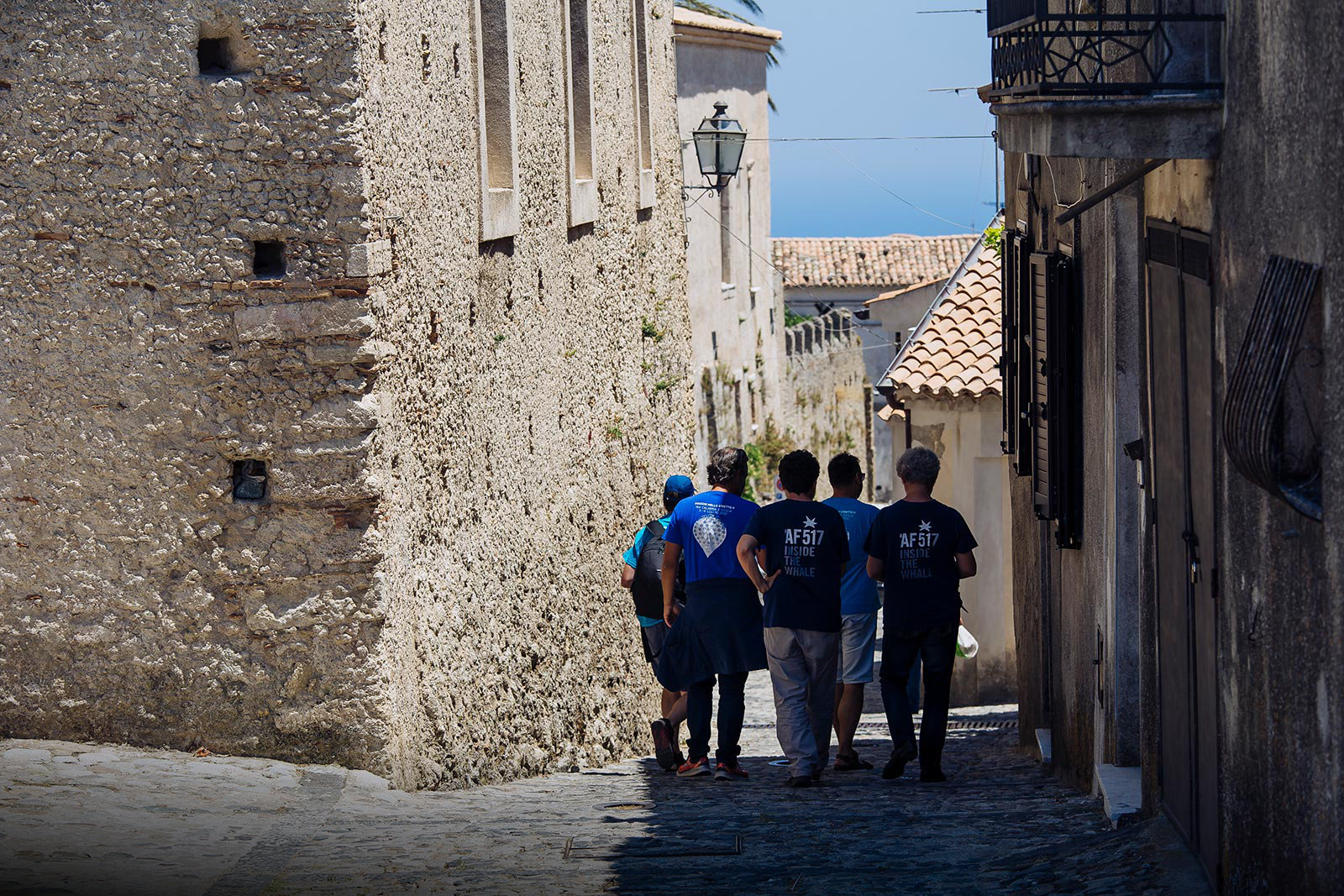
Alfonso Femia opens the third edition of Invisible Mediterranean(s) – Journey across the Strait.
“We can no longer just talk; for politics and architecture, it is time to act.”
It was not supposed to be a four-day event, nor was it meant to take place in September.
The idea was for it to last a full week, in June, during which field research on the territory would be combined with an organic re-examination of the themes and situations we had previously explored separately in the two earlier editions. I am referring to Invisible Mediterranean(s) – Journey Across the Strait III,, which despite the pandemic, we chose to undertake also – or rather especially – in 2020, albeit with reduced time and programming, in order to affirm the need and the will to state that the South can no longer be read, interpreted, and experienced as it has been up to now.
It is precisely 2020 that marks the first demonstration of how strong the South can be, and how this strength can sustain the country as a whole.
I believe that what Invisible Mediterranean(s) has revealed – and will continue to reveal – is important for the country. As we will read in the interviews with representatives of local public administrations, presidents of professional orders, and Sicilian and Calabrian architects, the meaning of words and actions can change when the perspective and gaze are different, and above all when dialogue and confrontation take place on site.
“Infrastructure”, “school”, “village”, “territory” carry different meanings and nuances in places such as Messina compared to places like Siena or elsewhere, and the evidence of this diversity must be strengthened and made more widely known.
There is no romanticism in the gaze of Invisible Mediterranean(s). Each investigation brings to light problems that can no longer be confined within an isolated identity, but must instead be expressed and resolved through connection with other identities. Citiens exist within territories, just as villages do, just as landscapes, coastlines, and mountains do. And Journey across the Strait reveals these connections and the overall system of relationship that binds them together.
Citing Cyprian Broodbank, author of “Il Mediterraneo” (Einaudi, 2015), perhaps the most interesting and brilliant narrative on the subject in the last decade, the characteristics of the Mediterranean are often taken as given facts. Yet the Mediterranean system is made up of closely interconnected centers, whose surprising economic and cultural development has become a model for the entire world. As Broodbank writes: “The Mediterranean of prehistory, a microcosm where everything has come to a standstill, is the perfect model for helping us investigate the globalized world in which we live”.
For example, in the past, highly original civilizations such as Cyprus and Malta, which reached peaks of development, were later reabsorbed into the dominant trend – and this represents, in Broodbank’s view, “the dark side of globalization. A warning message for all of us”.
And is the contemporary Mediterranean a sea of relations?
“Absolutely. If in the past it experienced both moments of confrontation and conflict, the prevailing message that emerges is that of a place of encounter – a place where stereotypes are constantly challenged and dismantled”, says Cyprian Broodbank. We strongly believe that, starting from the second half of 2020, national and European policies must invest in the Southern Mediterranean of Italy. Not as an act of compassion, but as a new center of energy for the entire Old Continent.
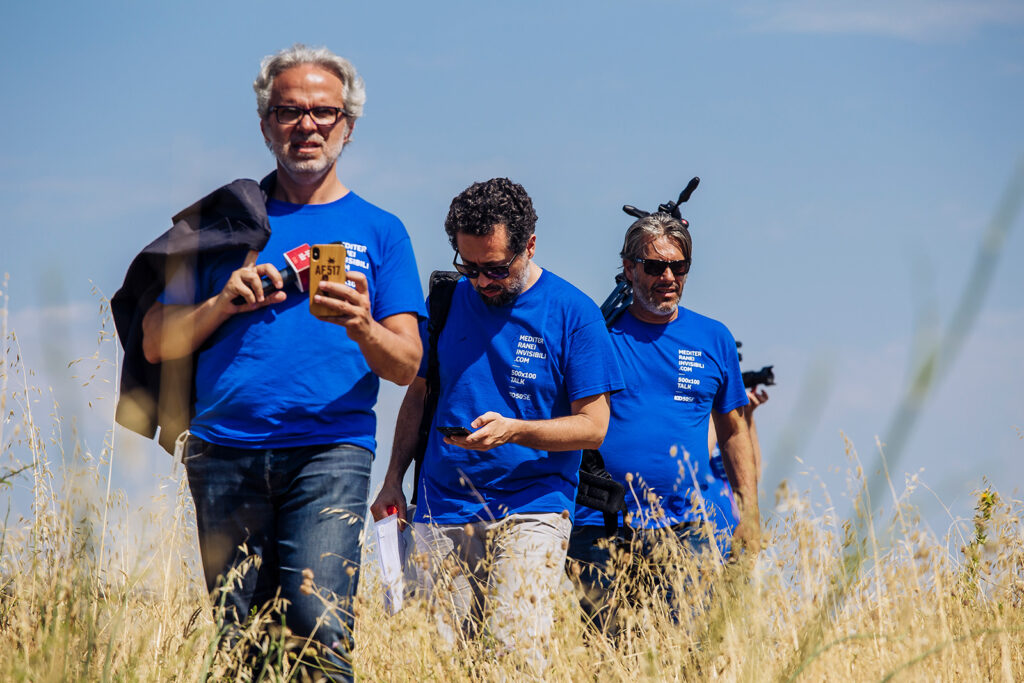
The exploration Invisible Mediterranean(s), with the third Journey across the Strait, resumes together with Marco Predari (500×100) and Giorgio Tartaro, journalist who followed the previous editions, capturing the invisibility not only of the Mediterraneans, but also of journeys themselves.
GIORGIO TARTARO’S NEUROIMAGING FOR INVISIBLE MEDITERRANEAN(S)
Let’s play a game.
A videogame.
Or rather, a game of images.
To make the invisible Mediterranean visible – even in its plural form – we can imagine the bounce of a ball. A basketball, perhaps. And imagine its sound in an empty gym.
As a bearer – hopefully a healthy one – of internal Invisible Mediterranean(s), as a lake dweller who loves the sea, I imagine this ball bouncing from Greek and Latin epics to the recent image of a Mediterranean rotated ninety degrees: unrecognizable, yet fascinating, like a future highway.
From Phoenician and Roman splendours to the Maritime Republics, from the fragmented history of a richly biodiverse “boot-shaped” country to the troubled process of Italian unification, from times of excessive government to times of no government at all… It is astonishing to think that, apart from devastations and agricultural, artisanal, and industrial revolutions, many – very many – things have fortunately endured.
For instance, the desire for discovery: just as in coastal landscapes, so too in inland, pre-Alpine and mountainous ones, it reveals exemplary moments of recognition. Tradition, the will to recover, effort, commitment, attachment, people, identity.
The encyclopaedists work on these dynamics and return splendours. The fact is that Invisible Mediterranean(s) bounces very high. It elects a “Virgil 4.0” and surgically identifies heterodox contemporary heroes – those who fight against the common opinion of the obvious, who research, design, study, involve, and connect… in short, as my children would say, they really go all in.
No, it is not just cool or picturesque: it is an ethical and luminous way of being in time, this telling of Invisible Mediterranean(s).
Those that some know and hide. Those that many long for and cannot find. Those that, sometimes, by sheer luck, we happen to encounter.
And then it becomes a kind of drama. Because they are like beautiful songs, refrains, synthetic dependencies you can’t quite escape.
Travel is about seeing with new eyes…new sounds, scents, energies, sensations, friends, anecdotes…in short: human beings. Women and men who, outside the uniform of formality, rejoice in telling, collecting, giving.
For me, Invisible Mediterranean(s) are everything that escapes the individual, egoism, the idea of status and social position.
Once Muhammad Al began a speech in public. He apparently didn’t quite know what to say. At some point, he said: “Me, we”.
He then reportedly reworked the “Me, We” pronounced at Harvard in 1965 into “Me, Whee” a joyful “me!”, or rather “I? Hooray!” Perhaps suggested by his team or by circumstance.
Personally, I prefer the first version. Which is also my point of view on the Invisible Mediterranean(s), seen from the kaleidoscopic position of the Inner Mediterraneans: it is, fully and legitimately, an “I,we”. A-Sea Our Sea.
YOU CAN START AGAIN FROM THE SOUTH, BY MARCO PREDARI
Invisible Mediterranean(s) is part of the broader project of Marco Predari, 500×100, which was launched five years ago with the aim of investigating, through dialogue, paths of built and conceptual architecture. It has progressively strengthened and expanded, moving from its first Milan-based experience at the Salone del Mobile to other national contexts, including Venice, Rome, Pisa, and the South.
It represents an important commitment for a company such as Universal Selecta, a leading organization that this year won the Compasso d’Oro in the “Office Furniture and Accessories” category. The company supports the process of growth in Southern regions through the encounter and alignment between politics and architecture, also through the 500×100 platform.
As a company, we share initiatives rich in content in Puglia, Sicily, and Campania, and we believe that the entire South can be transformed from an area of development into a territory for validating effective experiences.